

I2026-1 Investigations of Improper Activities by State Agencies and Employees
October 1, 2026
Investigative Report I2026-1
The Governor of California
President pro Tempore of the Senate
Speaker of the Assembly
State Capitol
Sacramento, California 95814
Dear Governor and Legislative Leaders:
The California State Auditor, as authorized by the California Whistleblower Protection Act, presents this report summarizing some of the investigations of alleged improper governmental activities that my office has recently completed. This report details nine substantiated allegations involving several state agencies. Our investigations found waste, inefficiency, misuse of state resources, contracting violations, and other improper governmental activities. Our findings include approximately $885,000 that state agencies have wasted, misused, did not collect, or spent on purchases that they did not properly advertise.
For instance, an agency cost the State an estimated $107,000 when it did not reduce leave balances for two employees who took leaves of absence. We determined that this error originated in the agency’s lack of adequate controls. In another case, an agency enacted a poorly conceived plan to address two employees’ accounts receivable, delaying the agency’s collection of over $33,000 from the employees for more than a year. We also found that an agency did not advertise solicitations for nearly $624,000 worth of Non-IT goods, so the agency could not ensure that it received the most competitive prices for its purchases. An employee at another agency cost the State $69,000 by misusing a state vehicle and state time for his personal commute.
State agencies must report to my office any corrective or disciplinary action that they have taken in response to recommendations that we have made. Their first reports are due within 60 days after we notify them of the improper activity, after which they report monthly until they have completed the corrective action.
Respectfully submitted,
GRANT PARKS
California State Auditor
Selected Acronyms Used in This Report
| CAL FIRE | California Department of Forestry and Fire Protection |
| CalHR | California Department of Human Resources |
| CalRecycle | California Department of Resources Recycling and Recovery |
| Caltrans | California Department of Transportation |
| CDE | California Department of Education |
| CLETS | California Law Enforcement Telecommunications System |
| DGS | Department of General Services |
| DHCS | Department of Health Care Services |
| DMV | Department of Motor Vehicles |
| DOJ | California Department of Justice |
| DPAC | Caltrans Division of Procurement and Contracts |
| SCM | State Contracting Manual |
| SCO | State Controller’s Office |
| SPB | State Personnel Board |
Summary
Results in Brief
Under the authority of the California Whistleblower Protection Act, the California State Auditor’s Office (State Auditor) conducted investigative work from July 1, 2025, through June 30, 2026, on 1,721 allegations of improper governmental activity, some of which we received prior to this time period. Some of these investigations substantiated improper activities, including waste, inefficiency, misuse of state resources, contracting violations, and other improprieties. We provide information in this report on only a selection of the cases we have investigated as a deterrent for state agencies and state employees so they can avoid similar improper governmental activities.
The Department of Health Care Services did not reduce an employee’s leave balances for two instances of maternity leave, costing the State an estimated $86,000. During our investigation, we found another employee whose leave balances it also did not reduce when she took maternity leave, and we found that the agency did not have adequate controls in place to reduce employees’ leave hours when they took such leaves of absence.
The State Controller’s Office violated state law by failing to collect the accounts receivable for an employee, and its high‑ranking officials formed a poorly conceived plan for how to address the accounts receivable for this and another employee, resulting in an unnecessary, year‑long delay in collecting more than $33,000 from both employees.
Additionally, two employees at the State Controller’s Office teleworked from Idaho, Tennessee, and Alabama while they did not reside in California, contrary to state law.
An employee at the California Department of Forestry and Fire Protection improperly used a state vehicle to commute between his headquarters and his home or near his home for about five years, costing the State an estimated $42,000. The employee also improperly included commute time between his home and headquarters as time worked, costing the State an estimated $27,000 in salary paid for work not performed.
An employee at the California Department of Resources Recycling and Recovery violated the law and misused state funds by renting and driving vehicles for more than one year after her license had been suspended. As a result, the employee put the public at risk, and the State paid nearly $22,000 in expenses for rental vehicles and fuel that the employee incurred while she was not licensed to drive.
A high‑ranking law enforcement officer misused access to a confidential law enforcement database by looking up information about himself, his family members, agency staff, and vehicles without a business purpose for doing so. We are not naming the agency that is the subject of this report because doing so may identify or lead to the identification of the individuals mentioned in the report, which would violate state law.
A manager at the California Department of Education improperly facilitated the hire of an employee with whom she had a long‑term friendship and, together with the employee, failed to satisfy the requirement that civil service appointments be made and accepted in good faith, which resulted in the employee’s appointment being unlawful.
The California Department of Transportation’s Division of Equipment neither completed required written solicitations nor advertised for competitive pricing for nearly $624,000 worth of non‑information technology goods in 2024, resulting in the agency’s failure to comply with state contracting requirements and its inability to ensure that it received the most competitive prices for its purchases.
The California Student Aid Commission selected the most expensive vendor for automated call services, expedited the contract just prior to the end of the fiscal year, and did not follow State Contracting Manual requirements to keep adequate documentation of its procurement process and contractor selection. Consequently, it may not have received the best value on the contract.
Introduction
Under the California Whistleblower Protection Act (Whistleblower Act), anyone who reports in good faith an improper governmental activity is a whistleblower and is protected from retaliation.1 An improper governmental activity is any action by a state agency or by a state employee performing official duties that does any of the following:
- Violates state or federal law.
- Is economically wasteful.
- Involves gross misconduct, incompetence, or inefficiency.
- Does not comply with the State Administrative Manual, the State Contracting Manual, an executive order of the Governor, or a California Rule of Court.
Whistleblowers are critical to ensuring government accountability and public safety. The State Auditor protects the identities of whistleblowers and witnesses to the maximum extent required by law. Retaliation against state employees who file reports is unlawful and may result in monetary penalties and imprisonment.
Ways That Whistleblowers Can Report Improper Governmental Activities
Individuals can report suspected improper governmental activities through the toll‑free Whistleblower Hotline (hotline) at (800) 952-5665, by U.S. mail, or through our website at http://www.auditor.ca.gov/whistleblower/.
Investigation of Whistleblower Allegations
The Whistleblower Act requires our office, as the recipient of whistleblower allegations, to investigate and, when appropriate, authorizes us to report on substantiated improper governmental activity by state agencies and state employees. We may conduct investigations independently, or we may request assistance from other state agencies to perform confidential investigations under our supervision.
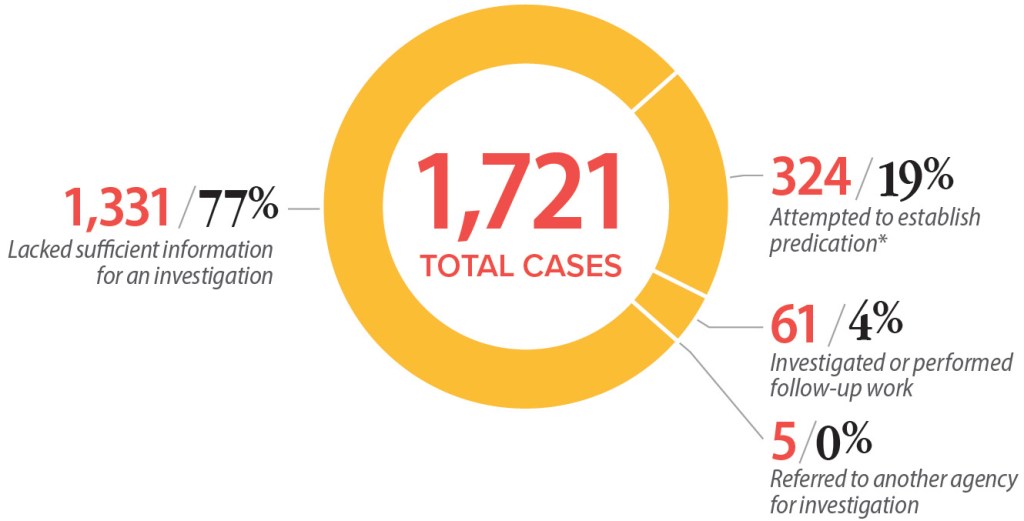
As Figure 1 shows, 1,331 of the 1,721 cases for which we conducted investigative work lacked sufficient information for investigation. For another 324 cases, we conducted work—such as analyzing available evidence, contacting witnesses, and requesting information from state agencies—to assess the allegations. We independently investigated or performed follow‑up work on implementing recommendations for another 61 cases, and we referred five cases to relevant agencies that could further investigate the matters.
Figure 1
Status of 1,721 Cases, July 2025 to June 2026
Source: State Auditor.
* Predication is reasonable cause to investigate an allegation. Establishing predication generally includes analyzing available evidence, contacting witnesses, and requesting information from state agencies.
Figure 1 shows a pie chart of the disposition of the 1,721 cases that the investigations division staff worked on from July 2025 through June 2026. 1,331 of the 1,721 cases, or 77 percent, lacked sufficient information for an investigation. Staff attempted to establish predication on 324 of the 1,721 cases, or 19 percent. Staff investigated or performed follow-up work on 61 out of the 1,721 cases, or four percent. Five of the 1,721 cases, or zero percent, were referred to another agency for investigation. The source of this information is the California State Auditor.
The Whistleblower Act authorizes the State Auditor to issue public reports when investigations substantiate improper governmental activities. When issuing public reports, our office must keep confidential the identities of the whistleblowers, any employees involved, and any individuals providing information in confidence to further the investigations. In this report, we may have changed how we refer to the gender of individuals involved in our investigations to protect their identities.
We may also issue nonpublic reports to the heads of the agencies involved and, if appropriate, to the Office of the Attorney General, the Legislature, relevant policy committees, and any other authority we deem proper. Our office cannot release the identities of the whistleblowers or any individuals providing information in confidence to further the investigations without those individuals’ express permission.
Our office performs no enforcement functions: this responsibility lies with the appropriate state agencies, which are required to regularly notify us of any actions they take in response to the investigations, including disciplinary actions, until they complete their final actions.
Investigative Results
Department of Health Care Services
It Did Not Charge Multiple Employees’ Leave Balances While They Were on Extended Leaves of Absence
CASE I2025‑3231
Summary of Allegations and Investigative Results
In response to an allegation that the Department of Health Care Services (DHCS) did not reduce leave balances for an employee (Employee A) while she was on maternity leave, we initiated an investigation. Our investigation determined that DHCS did not reduce Employee A’s leave balances for two instances of maternity leave, which cost the State an estimated $86,000. When investigating this case, we found that DHCS did not have adequate controls in place—such as regular audits of employees’ leave usage—to ensure that it reduced employees’ leave hours when they took such leaves of absence. We found another instance in which DHCS did not reduce an employee’s (Employee B) leave hours while she was out on maternity leave, costing the state an additional $21,000.
About the Agency
DHCS’ purpose is to provide health care services to eligible residents, such as individuals and families with low incomes, by financing and administering Medi-Cal, the State’s Medicaid program.
Background
DHCS employees, like all state employees, are entitled to a one‑year unpaid, job‑protected leave of absence for the birth or adoption of a child. If a DHCS employee chooses to use accumulated leave hours to receive pay for some or all of that time off, they may request a leave of absence, such as maternity leave, by notifying their manager, contacting their Human Resources office, and completing appropriate forms, which requires them to elect whether they intend to use their accumulated leave hours to supplement their time off.
The California Code of Regulations, title 2, section 599.665, requires each appointing power—like DHCS—to keep complete and accurate attendance records for each employee. Furthermore, the State Administrative Manual section 8534.1 requires state agencies to create an audit process to review and correct leave input errors each month.
DHCS Did Not Reduce Employee A’s Leave Balance for Two Separate Maternity Leaves of Absence
Between 2021 and 2024, Employee A took a maternity leave of absence twice, and DHCS did not reduce her leave balances in either instance. For her first leave of absence in 2021, our review of her pay records and leave balances revealed that she received her full pay and did not have any leave reductions during this time. Employee A asserts that she submitted the required paperwork to both her Human Resources Office and the Employment Development Department; however, because of the elapsed time and absence of records, we could not verify her assertion. For her second maternity leave of absence, we do have evidence that Employee A submitted the required paperwork indicating that she wished to supplement her time off by using her leave balances to receive full pay. We estimate that between these two leaves of absence, DHCS did not reduce her leave by 616 and 604 hours, respectively, which equates to about $86,000 in salary.
Although Employee A claimed to have been unaware that DHCS had not reduced her leave balances, she received monthly emails from DHCS summarizing her leave balances, which clearly showed that her leave hours had not been reduced. We also obtained credible evidence that she became aware but did not take any action to notify DHCS to correct these mistakes.
DHCS’ Process for Extended Leaves of Absence Was Inadequate, and More Employees’ Balances Are Likely Incorrect
In late 2024, DHCS began using the California Leave Accounting System with the State Controller’s Office. However, we found that before that time, DHCS’ process for charging employees’ leave balances was inadequate: an attendance coordinator in each division would read the employees’ leave hours from their timesheets and enter them into a leave balance database. A Human Resources representative reported that this process created problems because the attendance coordinators were not experts in keying in disability or extended leaves of absence and could enter incorrect information without Human Resources staff’s knowledge. We also learned that DHCS did not regularly audit employees’ leave usage for errors, as state policy requires. Furthermore, a Human Resources representative informed us that DHCS had a large backlog of disability requests, which may have contributed to the employee’s leave balances being incorrect. Finally, DHCS was also unable to locate timesheets for Employee A for her second maternity leave, and a Human Resources representative informed us that the department can issue pay without having an employee’s timesheet, which likely explains why she continued to receive full pay despite not having a completed timesheet.
Because we identified some process weaknesses, we took steps to determine whether uncharged leave balances was more widespread than the one case that a whistleblower reported to us. We reviewed a sample of 25 employees who took extended leaves of absence in 2024 and found one other employee (Employee B) whose leave balances DHCS did not reduce for an approximate three‑month leave of absence, which equated to about $21,000 in salary paid. Based on the results of this investigation, we estimate a high likelihood that other DHCS employees who took extended leaves of absence have incorrect leave balances.
Recommendations
To remedy the effects of the improper governmental activities this investigation identified and to prevent those activities from recurring, DHCS should take the following actions:
- Determine the specific number of hours DHCS should have charged both employees for their maternity leaves of absence and subsequently reduce all leave balances that it is able to reduce or establish an accounts receivable for the amounts they were paid while on leave.
- Determine whether Employee A’s failure to notify DHCS of the oversight in both instances warrants corrective or disciplinary action and take any actions it deems appropriate.
- Require its Internal Audits staff to audit the leave records of employees who took an extended leave of absence in calendar years 2023 and 2024 to ensure that DHCS properly reduced the employees’ leave balances.
- Review its current process for leave reporting to ensure that it provides proper oversight of timesheets and leave usage for employees who go on extended leave and bolster the process as warranted.
- Implement a process that complies with state policy to conduct regular audits of employees’ leave balances.
Agency Response
DHCS reported that it has reviewed the extended leaves of absence taken by the employees and plans to reduce their leave balances accordingly after verifying the appropriate number of hours needing reduction. It stated that its Human Resources staff will review its policies and procedures to determine whether corrective action is necessary for Employee A. It also reported that its Human Resources staff will review extended leaves of absence taken during 2023 and 2024 to ensure that employees’ leave balances were reduced accordingly and that its Internal Audits will review the assessment. Finally, it noted that it has implemented changes to its timesheet completion process for employees on extended leave, and plans to implement a new electronic time reporting system that will allow for more accurate leave accounting. It has not provided information on how it plans to ensure that it conducts regular audits of employees’ leave balances.
State Controller’s Office
It Did Not Collect More Than $33,000 in Overpayments It Made to Its Own Employees
CASE I2025‑4034
Summary of Allegations and Investigative Results
In response to an allegation that high‑ranking officials at the State Controller’s Office (SCO) directed subordinate staff not to collect accounts receivable for two employees, we initiated an investigation. We determined that the SCO violated state law when it did not collect the accounts receivable for one of the employees. We additionally determined that the SCO officials formed a poorly conceived plan for how to address the employees’ accounts receivable and never put the plan into action, resulting in a significant inefficiency. Specifically, the officials’ actions prevented the SCO from collecting the accounts receivable—which totaled more than $33,000—for more than a year.
About the Agency
As the agency responsible for accounting for and disbursing the State’s financial resources, the SCO employs about 1,500 individuals. One of the duties that its employees perform is administering the state payroll system and processing all personnel and payroll transactions.
Background
When the State overpays an employee and must collect that overpayment amount, SCO staff processes an account receivable for the overpayment. If the State overpays a current SCO employee, the SCO’s Human Resources division is responsible for providing notice to the employee and collecting the account receivable.
Government Code section 19838 requires state agencies to notify employees of overpayments and to provide the employees with an opportunity to respond and reach a mutual agreement as to how the agency will collect the overpayment. State law allows for three collection options: direct payment from the employee, payroll deduction, or leave credit reduction. Government Code section 19838 and the State Administrative Manual section 8293.2 require that should a state agency be unable to reach an agreement with an employee about how that employee will repay the overpayment, a state agency shall collect the overpayment via payroll deduction.
Not directly related to the accounts receivable process, the Department of General Services (DGS) administers the government claims program, which allows anyone to submit a claim for payment of damages caused to them by the State. Examples of government claims can include payments for damage to private property caused by state‑owned property or payments for reimbursements that a state agency failed to pay.
The SCO Failed to Collect Two Employees’ Accounts Receivable
In 2024, the California Department of Human Resources (CalHR) concluded the SCO had established monthly salary rates for two employees (Employee A and Employee B) that were higher than the amounts allowed under CalHR policy, resulting in overpayments to both employees totaling more than $33,000. To collect the salary overpayments, CalHR required the SCO to establish accounts receivable for both employees. In February 2025, the SCO established these accounts receivable, which totaled about $19,500 for Employee A and $13,700 for Employee B. However, despite providing the required notices to both employees about the amounts owed in a timely manner, the SCO had not collected the overpayments from either employee as of May 2026.
The SCO violated state law by not collecting the overpayments from Employee A. Employee A failed to respond when the SCO notified her of her account receivable, and therefore the SCO was unable to reach an agreement with her as to how she would repay the State. In accordance with state law and the State Administrative Manual, SCO’s Human Resources division initiated collecting Employee A’s account receivable via a payroll deduction in March 2025. However, that same month, a Human Resources manager (HR Manager C), who is no longer with the SCO, directed Human Resources staff to cancel Employee A’s payroll deduction because the SCO executive office was exploring an alternate means of satisfying the account receivable. Because Employee A and the SCO did not reach an agreement as to how she would repay her account receivable, the SCO was required to move forward with a payroll deduction and HR Manager C’s direction to cancel it violated state law.
When HR Manager C directed the SCO’s Human Resources staff to cancel Employee A’s payroll deduction, he also told them not to collect the other account receivable for Employee B. After the SCO notified Employee B that it had established an account receivable for her, Employee B reached an agreement with the SCO that she would pay back the amount owed using her leave credits. Because Employee B and the SCO reached this agreement, state law did not require the SCO to collect her account receivable within a specified time frame.
According to HR Manager C, he directed his staff to cancel Employee A’s payroll deductions and Employee B’s repayment through leave credits because two SCO executives (Executive D and Executive E) indicated plans to address the accounts receivable through DGS’ government claims program, which would have allowed the employees to receive payment for damages from the State caused by the SCO’s salary error. HR Manager C indicated that Executive D directed him that the SCO should not pursue payroll deductions to collect the accounts receivable because the SCO was in the process of submitting the issue as a government claim. However, Executive D told us that he did not have the authority to direct HR Manager C on the accounts receivable. Executive E, who outranks both HR Manager C and Executive D, claimed to have not directed anyone to discontinue collection of the accounts receivable, but acknowledged that not collecting the amount due would have aligned with “the collective decision” between the three of them to pursue the government claim process because they believed that the overpayments were not the employees’ fault.
However, the idea to use the government claims process was poorly conceived, and it is unlikely that the accounts receivable for both Employees A and B would have met the criteria for a government claim. To qualify for a government claim payment, the employees must have experienced damages; however, having received overpayment from the State does not constitute damages. Also, multiple SCO staff with experience processing employee account receivables reported that they were unaware of any prior instances in which overpayments to employees were addressed through the government claims process. Further, HR Manager C—who has many years of Human Resources experience—explained that this would have been the first time in his experience that an employee’s accounts receivable were appealed through a government claim.
Despite this apparent agreement to use the government claims process, none of the officials we interviewed contacted the state agency responsible for administering government claims. Executive E was unaware of who at the SCO would have reached out to government claims and had not directed anyone to do so. HR Manager C has since left state service but informed us that he had told Executives D and E that he would not contact government claims. Executive D told us that he had not contacted the government claims agency and had not had subsequent conversations with or received direction about the issue from Executive E.
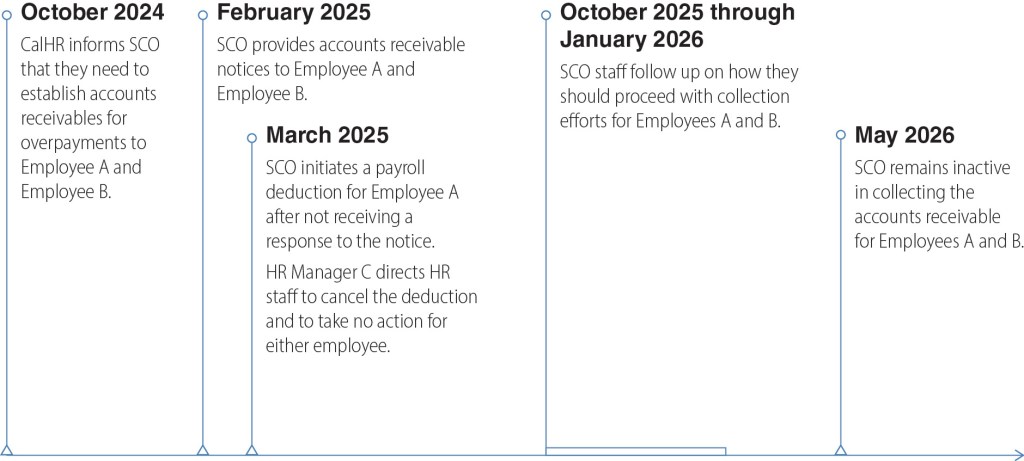
Ultimately, the SCO’s entire approach to resolving the overpayments, specifically the actions of HR Manager C, Executive D, and Executive E to purposefully delay collection in favor of an alternate approach that they never actually pursued, was highly inefficient and, as we show in Figure 2, resulted in the SCO not taking action for more than a year after establishing the accounts receivable. The SCO had multiple opportunities to resolve the two employees’ outstanding receivables. For example, we identified emails sent by other SCO staff, including other executives, seeking direction on how to proceed with collecting the accounts receivable for both employees. We also learned that in early 2026 another SCO executive had spoken to Executive E about the accounts receivable and that the other SCO executive hoped to meet with Executive E again to identify the next steps to take.
Figure 2
The SCO Took Limited Action to Collect the Accounts Receivable for More Than a Year
Source: SCO records and witness statements.
Figure 2 displays a timeline from October 2024 to May 2026 showing the limited action SCO took to collect the accounts receivable. The first point of the timeline is October 2024. The text states that CalHR informs SCO that they need to establish accounts receivables for overpayments to Employee A and Employee B. The second point of the timeline is February 2025. The text states that SCO provides accounts receivable notices to Employee A and Employee B. The third point of the timeline is March 2025. The text states that SCO initiates a payroll deduction for Employee A after not receiving a response to the notice and that HR Manager C directs HR staff to cancel the deduction and to take no action for either employee. The fourth point of the timeline is October 2025 through January 2026. The text states that SCO staff follow up on how they should proceed with collection efforts for Employees A and B. The final point of the timeline is May 2026. The text states that SCO remains inactive in collecting the accounts receivable for Employees A and B. The source of this information is SCO records and witness statements.
Finally, by not collecting the accounts receivable for Employee A and Employee B for more than one year while also not taking meaningful steps to explore the government claim process as an option, the three SCO officials have risked providing SCO employees with a gift of public funds. This condition will continue as long as the SCO remains inactive in collecting the amounts due. When asked if any additional obstacles would prevent the SCO from collecting the accounts receivable, Executive E said that there were no other obstacles that would prevent collection.
Recommendations
To remedy the effects of the improper governmental activities this investigation identified and to prevent those activities from recurring, the SCO should take the following actions:
- Immediately begin collecting the overpayment made to Employee A and coordinate with Employee B’s current state employer to collect the overpayment made to her.
- Provide a reminder to all SCO staff who engage with the accounts receivable process and to all members of SCO executive management team about the requirements in law and the State Administrative Manual for collecting accounts receivable.
Agency Response
The SCO reported that it is in the process of implementing our recommendations, including reminding staff about the requirements governing accounts receivable collections, and that one employee has completely satisfied the account receivable and it is beginning deductions for the other employee.
However, in its response, the SCO reported that it disagrees that it violated state law with respect to not collecting the account receivable for Employee A because it complied with the requirement to initiate collection within three years. We respectfully disagree with this assertion that a violation of law did not occur because, as we note in the report, state law requires that the State proceed with recoupment through a payroll deduction if an employee fails to voluntarily agree to repay the funds. We identified that the SCO did initiate a payroll deduction for Employee A when she did not respond to her notice, but that HR Manager C directed staff without reasonable justification to cancel the deduction. The direction to cancel the deduction and initiate an indefinite delay in recouping funds therefore represents a failure to comply with the requirements in state law.
The SCO also asserted that there was no risk of a gift of public funds caused by its delay in collecting the accounts receivable for several reasons. First, the SCO asserted that the funds served a public purpose and therefore cannot be a gift of public funds. However, although salaries for state employees do serve a public purpose, there is neither a public purpose nor does it support the mission of the SCO to pay two of its staff at salary rates that exceed the maximum established by CalHR. The additional salary that the two employees were not entitled to receive did not serve a public purpose. Second, the SCO argued that for our statement about a risk of a gift of public funds to be accurate, every overpayment to a state employee would present such a risk. We disagree with the SCO’s position. As we discuss in the report, the specific accounts receivable we identified as posing a risk of a gift of public funds constituted a risk because the SCO made no collection efforts for more than a year despite repeated requests from staff for direction. Had the SCO delayed its collection efforts permanently, the overpayment would have resulted in a gift of public funds to these employees.
Finally, the SCO identified several concerns in its response about specific phrasing we used in the initial draft of our report. We have reviewed the underlying evidence and have not identified any factual inaccuracies with the information that we present. However, to help address some of the SCO’s concerns, we have made minor adjustments to the text where we believed it was warranted, which did not affect our overall conclusions.
State Controller’s Office
Two Managers Improperly Teleworked From Outside of California in Violation of State Law
CASE I2025‑2887
Summary of Allegations and Investigative Results
In response to an allegation that employees at the State Controller’s Office (SCO) teleworked from states other than California, we initiated an investigation and determined that two employees did telework from Idaho, Tennessee, and Alabama while they were not residing in California.
Background
Government Code section 14200 defines telecommuting, which we refer to as teleworking, as “the partial or total substitution of computers or telecommunication technologies, or both, for the commute to work by employees residing in California.” There is no explicit standard in state law for determining whether an individual resides in California for purposes of telework; however, other sections of the Government Code offer guidance, including that an individual can only have one residence, and an individual can only change their residence intentionally.
In February 2022, the California Department of Human Resources (CalHR) sent a notice to state departments’ Human Resources offices clarifying that departments shall not approve employees’ requests to regularly telework from an out‑of‑state location. CalHR’s guidance does allow departments to approve employee requests to temporarily telework from outside of California, such as for situations related to a reasonable accommodation or in accordance with the Family Medical Leave Act; however, departments should document such approvals in a signed telework agreement.
The SCO’s telework policy does not explicitly require that telework locations be in California. However, the policy allows employees to work one or more days away from an assigned facility, either at home or in a location conducive to being able to return to their assigned work location within their normal commute time upon receipt of a reasonable notice from management. The policy explicitly prohibits employees from “relocating to an area which precludes their ability to return to an assigned work location within normal commute time.”
Two Managers Did Not Inform the SCO That They Were Teleworking From Outside of California
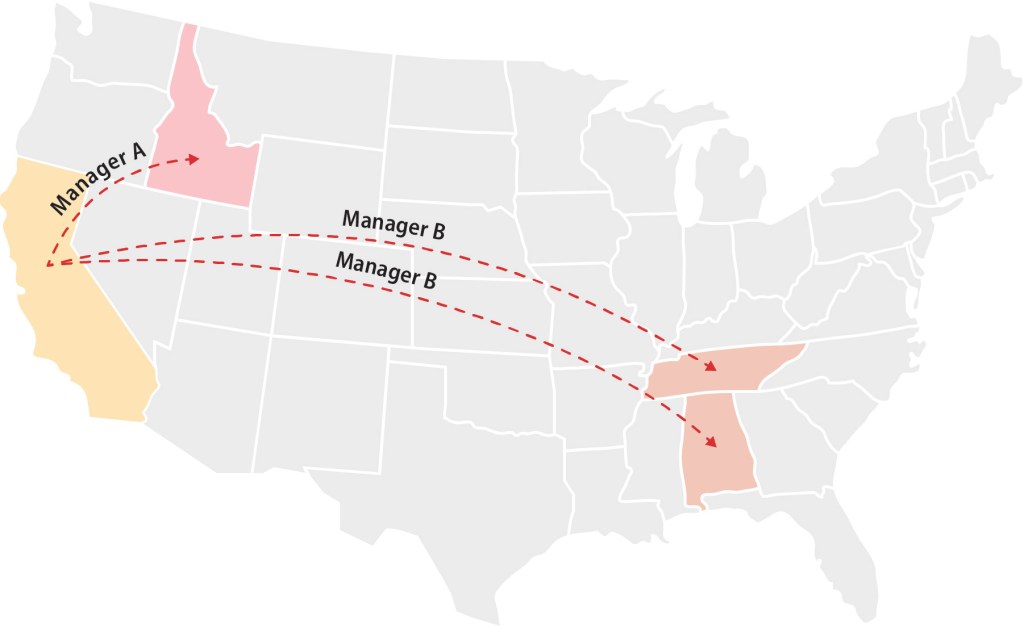
Our review of SCO records and interviews with SCO staff identified two staff services managers (Manager A and Manager B) who resided outside of California and teleworked from other states in violation of state law. As we show in Figure 3, we identified that these employees teleworked from Idaho, Alabama, and Tennessee. Neither manager informed the SCO of their out‑of‑state telework locations.
Figure 3
Two SCO Managers Teleworked From Other States
Source: SCO computer records.
Figure 3 displays a map of the continental United States with the states California, Idaho, Alabama, and Tennessee highlighted. There is an arrow from California to Idaho for Manager A. There are arrows from California to Alabama and California to Tennessee for Manager B. The source of this information is SCO computer records.
Manager A
Manager A began working and living in Idaho in November 2020 without disclosing this information to the SCO. To assess from where Manager A had accessed the internet with his SCO‑issued devices, we examined the IP address records for his assigned devices from June 2025 through September 2025 and saw that he regularly logged in from Idaho. In addition, public records show that Manager A owns property in Idaho and has an Idaho‑issued driver’s license. When we interviewed Manager A, he admitted to working from Idaho “just about every day” for about five years since he moved to Idaho in November 2020. Accordingly, Manager A’s teleworking activity did not comply with state law’s specification that telework is an option available only for state employees who reside in California.
Despite living and working in Idaho for approximately five years, Manager A did not disclose to anyone at the SCO his actual location. In each of the telework plans that Manager A signed in 2023, 2024, and 2025, he said that his telework address was in California. Manager A explained that the California address he reported on his 2025 telework plan belonged to a family member, and he confirmed that he did not disclose his accurate telework location to his supervisor or anyone else at the SCO out of fear of losing his job, which afforded him work‑life balance.
Manager B
We conducted a similar review for Manager B, and the evidence we gathered combined with her evasive answers led us to conclude that she likely resided outside of California, teleworked on her SCO‑issued device from both Alabama and Tennessee, and did not inform the SCO of her location, either verbally or in her signed telework agreements.
Manager B’s IP address log‑in data showed that she accessed the internet from Alabama about half of her work time and from California the other half from June 2025 through September 2025, and her access during October 2025 and November 2025 was exclusively from Alabama. We also identified IP address data that shows she logged in for work from Tennessee.
During the course of our investigation, we obtained a 2024 court order that identified her as a resident of Tennessee in at least 2024. Furthermore, Manager B reported on her 2023 tax documentation that her home address was in Tennessee. Finally, we located an email from Manager B in April 2025 in which she explained that she planned to move to Alabama. Although Manager B asserted during her interview that she planned to move to Alabama after separating from state service, the IP address information we reviewed indicates that Manager B has been present in Alabama and has increased the amount of time she spends there.
When we questioned Manager B about either the IP address information or the documentation purporting her residency outside of California, she reiterated that although she worked from Alabama and Tennessee, she did not live outside of California. However, we found her explanation not credible and believe that she is more likely than not a resident of another state and is therefore ineligible to participate in telework as a California state employee.
In addition to acknowledging that she did telework from both Tennessee and Alabama, she also admitted that she did not inform her supervisor of her telework from either location, and she did not disclose her actual telework locations on the telework plans she signed in 2023, 2024, or 2025, each of which list her telework location as being in California.
The SCO Lacks Clear Policy Guidance and Internal Controls to Prevent and Detect Out‑of‑State Telework
Although neither Manager A nor Manager B disclosed or accurately documented on their telework plans that they regularly teleworked from outside of California, the SCO could have provided better guidance and stronger internal controls to ensure compliance with CalHR’s 2022 guidance and to detect or prevent the long‑term out‑of‑state telework in which both employees engaged.
When we reviewed the SCO’s telework policy, it contained no explicit language that employees must generally conduct telework from within California. Not surprisingly, Managers A and B both expressed that it was unclear whether they could telework from out‑of‑state. Manager A informed us that he was not aware of any departmentwide communication regarding telework location requirements. Manager B explained that it was her understanding that she could telework from outside of California as long as she lived in California. Accordingly, the SCO could provide its employees with clearer guidance regarding teleworking while residing in states other than California.
Although the 2022 guidance from CalHR allows state departments to approve temporary out‑of‑state telework in certain circumstances, it also requires that these temporary locations be documented on a signed telework plan. However, when we asked management in SCO’s Human Resources division about whether telework plans documented temporary changes to telework locations, the manager stated that the SCO does not require telework plans to be updated to reflect any temporary out‑of‑state telework locations. By not adhering to this guidance from CalHR, the SCO has lost an opportunity to monitor whether any of its employees are temporarily teleworking out‑of‑state, such as for a situation under a reasonable accommodation per CalHR, and whether those employees ultimately do return to California.
When we asked staff who work in the SCO’s Information Technology and Human Resources divisions whether the SCO verifies that employees are teleworking at the location identified on their telework plans, they said that the SCO does not typically monitor employees’ telework locations. A member of management in SCO’s Human Resources division noted that shortly before the start of our investigation, a report generated by the Information Technology division had made Human Resources aware that several SCO employees may be teleworking from out‑of‑state but that the SCO took limited action on the information so as not to interfere with our investigation. Despite this one report, without some form of review of the locations from which employees are teleworking, the SCO does not have a way to identify whether any employees may have violated the requirements in state law about teleworking while residing in a state other than California. Without such a process in place, the SCO risks withholding incorrect payroll taxes for employees because living in or working extensively from another state could trigger changes to employees’ tax liabilities.
Although CalHR has issued guidance to departments that they should not approve regular out‑of‑state telework, state law does not expressly define residency for the purpose of state employment; rather, it states that telecommuting is for employees residing in California. Thus, to make this determination, a department would need to rely on principles of residency and domicile relating to other circumstances where residency must be determined, such as those relating to elections and judicial jurisdiction. However, determining residency can be difficult and impose a significant burden on a department because to determine where an employee resides, the department would likely need to collect evidence for and consider factors such as voter registration, vehicle registration, and an employee’s physical location over a period of time. The department may also need to search other states’ records for indications of residency. To ease this burden for employers and to ensure that state law more clearly reflects the prohibition on regular out‑of‑state telework, the Legislature may wish to consider clarifying existing law to clearly state that state employees may not regularly telework from locations outside of the State of California unless they meet the limited exceptions for temporary out‑of‑state telework identified by CalHR.
Recommendations
Legislature
To provide clarity to state departments and employees regarding the permissibility of teleworking from out‑of‑state, the Legislature should amend state law to clearly provide that state employees may not regularly telework from locations outside of California.
SCO
To remedy the effects of the improper governmental activities this investigation identified and to prevent those activities from recurring, the SCO should take the following actions:
- Take action to bring Manager A and Manager B into compliance with state law with regards to their telework locations.
- Take appropriate corrective or disciplinary action against Manager A and Manager B for teleworking from locations not included on their telework plans.
- Update and disseminate to all SCO staff policies, procedures, and practices to comply with and communicate the provisions of Government Code 14200 and the guidance from CalHR regarding out‑of‑state telework.
- Implement a process to periodically monitor the locations from which employees are teleworking, such as by reviewing the locations of SCO‑issued mobile devices, to determine whether telework locations appear to violate either state law or departmental expectations.
Agency Response
The SCO informed us that it is finalizing an updated telework policy. The policy will include an internal process to periodically monitor the locations from which employees are teleworking. Additionally, both Manager A and Manager B have separated from the SCO. Finally, the SCO noted that it had tasked its Human Resources division to determine whether current employees were teleworking from outside of California but had learned that its staff had stopped this work while our office investigated the matter. The SCO reported that after it received our report, it immediately began to address the issues related to employees working outside of California.
California Department of Forestry and Fire Protection
An Employee Cost the State $69,000 by Misusing a State Vehicle and State Time for His Personal Commute
CASE I2025‑2448
Summary of Allegations and Investigative Results
In response to an allegation that an employee at the California Department of Forestry and Fire Protection (CAL FIRE) misused a state vehicle and state time for his personal commute, we initiated an investigation. Our investigation determined that the employee improperly used a state vehicle to commute between his headquarters and home or near his home for about five years. As a result, he cost the State an estimated $42,000. We also determined that the employee improperly counted on his timesheets his commute time between his home and headquarters as time worked, costing the State an estimated $27,000 in salary.
About the Agency
CAL FIRE serves and safeguards the people and protects the property and resources of California. In its effort to meet that mission, CAL FIRE manages mobile equipment, including state vehicles.
Background
CAL FIRE implements and maintains a telematics system, which is installed in some of its mobile fleet and includes a GPS system to collect data. Its mobile equipment storage policy notes that when an employee stores a state vehicle away from its assigned facility, the storage location should be located within a reasonable distance from the employee’s headquarters, which state law defines as the place where an employee spends the largest portion of their workday or work time or the place to which they return after completing special assignments.
It is unlawful for state employees to use public resources for personal purposes that are not authorized by law, and the law makes misuse of state property a cause for discipline. One example of vehicle misuse includes an employee driving a state vehicle to or from their home, unless the use meets one of a few exceptions, such as when the employee is required to respond to urgent or emergency calls outside of regular working hours, reasonably requiring the use of a state vehicle.
California Code of Regulations, title 2, section 599.808 requires employees who store a state vehicle at or in the vicinity of their homes for more than 72 nights over a 12‑month period or 36 nights in any three‑month period to obtain a vehicle home storage permit (home storage permit). Additionally, Government Code sections 8314 and 19990 prohibit employees from using state‑compensated time for personal purposes, and California Code of Regulations, title 2, section 599.665 requires agencies to keep complete and accurate attendance records for employees. According to the Department of Industrial Relations’ website, normal commute time does not count as work time.
The Employee Improperly Used a State Vehicle to Commute and Did Not Have a Home Storage Permit
Our investigation found that around 2020, the employee began using a state vehicle to commute between his home and his headquarters location approximately 50 miles away. The employee and his current manager noted that the employee’s primary duties entail transporting equipment from a particular location to where it is needed for fire mitigation work and operating the equipment on site. The employee told us that before he began taking the state vehicle home, he drove his personal vehicle from his home to his listed headquarters, where he would begin each workday. However, according to the employee, security issues arose in about 2020 after someone broke into his assigned state vehicle while it was parked at the CAL FIRE facility. The employee said that his manager at that time subsequently allowed him to store the state vehicle at a CAL FIRE station near his home. From that point forward, the employee began driving the state vehicle to either the fire station near his home or to his home at the end of each workday.
The employee did not regularly meet any of the exceptions outlined in state law to take a state vehicle home. For instance, he is not in an emergency response position, and although he could be assigned to an incident management team, his current manager clarified that he would know beforehand when he would be assigned. The manager suggested that taking the state vehicle home was more efficient because it allowed the employee to drive directly to whatever fire mitigation project he might be assigned to rather than driving to his headquarters to pick the vehicle up first. However, this explanation does not satisfy any of the exceptions within state law to justify the employee’s use of the state vehicle, and we disagree that allowing him to drive the state vehicle an extra 100 miles per day, mostly outside of his assigned unit, is an efficient use of state property. Further, the employee would typically need to drive from his home past or near his headquarters location to get to wherever he was working on a particular day. Therefore, we did not find any justification for the employee taking the state vehicle home: he could have stored the state vehicle at a secure fire station near his headquarters location. The employee told us that he thought he could take the state vehicle home for any reason as long as he did not exceed the threshold required to obtain a home storage permit. When we asked his manager if he met the requirements to take a state vehicle home, the manager informed us that he was not familiar with the requirements. He also mentioned that he inherited the employee’s vehicle situation from his predecessors and that he was not aware of what had been negotiated.
Our review of telematics data from August 2024 to July 2025 showed that the employee commuted in and stored the state vehicle 125 times, with 74 of the trips leading to storage of the vehicle at his home and 51 at a fire station near his home. If the employee’s vehicle use patterns were similar for each of the previous four years in which he commuted in the state vehicle, we estimate that he misused the state vehicle for approximately 66,000 miles, at a cost of about $42,000 based on the applicable Internal Revenue Service standard mileage rates.
The employee also violated state law requiring him to obtain a home storage permit because he stored the vehicle at his home on 74 nights during the 12‑month period between August 2024 and July 2025. State law requires anyone who stores a state vehicle at or in the vicinity of their homes for more than 72 nights during a 12‑month period to obtain a home storage permit. The employee confirmed that he did not have a home storage permit.
The Employee Did Not Work All the Hours He Claimed on His Timesheets Because He Improperly Counted All Commute Time as Work Time
The employee informed us that he counts the start of his workday as when he begins driving the state vehicle in the morning and the end of his workday as when he exits the state vehicle after returning home. However, an employee’s regular commute time is not considered compensable time. Thus, the employee’s drive back and forth between his home and his designated headquarters should not have been counted as work time. We reviewed a three‑month sample of the employee’s timesheets from May 2025 to July 2025 and compared the hours he claimed to have worked to his telematics data. We found that during this time, he claimed approximately 1.4 hours per day more than he actually worked. The manager agreed that the employee’s practice of including his commute time on his timesheets was improper and informed us that he was not aware of it. If the employee’s timekeeping practices remained constant during the entire period in which he was commuting in the state vehicle, we estimate that he would have received nearly $27,000 in wages for work that he did not actually perform.
Recommendations
To remedy the effects of the improper governmental activities that this investigation identified and to prevent those activities from recurring, CAL FIRE should take the following actions:
- Ensure that the employee discontinues the practice of commuting in the state vehicle and counting his commute time as time worked.
- Ensure that the employee’s headquarters are properly designated and determine the best place near his headquarters to store the state vehicle.
- Further investigate to determine the extent of the vehicle misuse, calculate the amount of funds it can recover for the misuse, and take appropriate steps to recover those funds, if warranted.
- Determine the amount of compensatory time the employee over‑claimed and take appropriate steps to hold him accountable for salary he received for work that he did not perform, including taking appropriate corrective or disciplinary action and collecting any overpayments made for hours that the employee did not work.
- Provide appropriate training to the manager on the proper use of state vehicles and on how to implement proper controls so that employees do not claim time that they do not actually work.
Agency Response
In December 2025, CAL FIRE reported that the unit chief informed the employee’s supervisor that the employee is required to report to his assigned duty station by his scheduled start time each workday. Further, CAL FIRE informed us that the employee’s supervisor provided the employee with the expectations that he should no longer take an assigned vehicle home and that he must store the vehicle at his assigned duty station. CAL FIRE also noted that it educated the employee’s supervisor on the proper use of state vehicles and the appropriate use of claimed time. By August 2026, CAL FIRE reported that it had completed its own investigation into the employee’s conduct, substantiated the allegations of misuse, and implemented appropriate action. CAL FIRE also initiated a validation of the financial data and intends to establish an accounts receivable after it finalizes its data.
California Department of Resources Recycling and Recovery
An Employee Endangered the Public by Driving With a Suspended License That the Agency Should Have Caught
CASE I2026‑1481
Summary of Allegations and Investigative Results
In response to an allegation that an employee with the California Department of Resources Recycling and Recovery (CalRecycle) drove state‑paid rental cars with a suspended license, we initiated an investigation. Our investigation determined that for over a year after her license was suspended in March 2025, an employee violated the law and misused state funds by renting and driving vehicles, including renting vehicles on 116 days when she was not scheduled to work. The employee’s actions put the public at risk, and the State paid $21,956 in rental vehicle and fuel expenses that the employee incurred when she was not legally allowed to drive. We also determined that CalRecycle’s process for enrolling employees who frequently drive rental vehicles in the Department of Motor Vehicle Employer Pull Notice Program (DMV notice program) is inefficient. The employee’s supervisor raised concerns about the employee’s driver’s license status to the Human Resources Branch in February 2026, and CalRecycle determined that no one in the supervisor’s unit, including the employee, was enrolled in the DMV notice program. The employee resigned during our investigation.
About the Agency
CalRecycle oversees the State’s Beverage Container Recycling Program, and the Division of Recycling regulates the operations of stand-alone recycling centers and retailer redemption locations to ensure that they follow the recycling program rules.
Background
The primary responsibility of some employees in CalRecycle’s Division of Recycling is to independently conduct on‑site inspections of beverage dealers and recyclers to ensure their compliance with the California Beverage Container Recycling and Litter Reduction Act and related regulations. These employees drive to inspection sites throughout their assigned regions, and the supervisor explained to us that her staff regularly conduct site inspections four days per week and that they primarily drive rental vehicles to those sites.
Department policy and duty statements require employees who travel frequently—taking six or more trips per month—to have a current, valid California driver’s license, maintain a good driving record, and participate in the DMV notice program, which allows CalRecycle to monitor its employees’ driving records. Further, employees must notify CalRecycle whenever their driver’s license is suspended, revoked, or reinstated. Various state laws and policies, including those listed in the text box, require individuals who drive a vehicle to have a valid driver’s license.
Requirements to Drive a Vehicle as a State Employee:
- California Vehicle Code Division 6 Chapter 4 prohibits a person from driving a vehicle with a suspended or revoked license.
- California Code of Regulations, title 2, section 172, requires employees who drive as part of their duties to hold a valid state driver’s license.
- State Administrative Manual (SAM) section 0751 requires those driving on state business to also maintain insurance and a good driving record.
The State Administrative Manual section 0751 provides that state agencies may participate in the DMV notice program if its employees frequently operate vehicles for state business. The DMV notice program allows departments to monitor the driving records of employees who drive on behalf of the department to perform their duties. To notify employers about employees’ license suspensions or revocations, the DMV notice program transmits employees’ driving records to their employers annually.
The Employee Misused State‑Paid Rental Vehicles by Driving With a Suspended License for More Than a Year
The employee’s driver’s license was suspended on March 29, 2025. More than a year later, on May 27, 2026, the DMV informed us that it had no records that the employee had satisfied the necessary requirements to have her license reinstated. The employee did not notify anyone in CalRecycle, including her supervisor, that her license was suspended, despite CalRecycle’s policy requiring this notification. In addition, CalRecycle staff informed us that the employee failed to enroll in the DMV notice program, despite the Business Services Unit and Human Resources Branch making multiple requests for her to do so.
Even with a suspended license, the employee regularly rented and drove vehicles under CalRecycle’s account at a rental car company. From April 1, 2025, to April 27, 2026, rental statements for CalRecycle’s account listed the employee as the renter and only driver of 46 vehicles and show that she rented vehicles on 345 of 391 calendar days. After reviewing the employee’s timesheets, we determined that she rented vehicles on 116 days when she was not working, including weekends and days when she used personal leave. The employee’s actions put the public’s safety at risk by driving with a suspended license. Moreover, the State paid $21,956 in rental vehicle and fuel expenses. Government Code section 8314 prohibits employees from using public resources for unauthorized purposes. By operating vehicles without legal authorization, the employee violated state law and misused government funds.
In February 2026, after overhearing the employee’s conversation with coworkers, the supervisor notified a supervisor in the Human Resources Branch of her suspicions that the employee’s driver’s license was invalid and requested verification of the status of the employee’s driver’s license through the DMV notice program. A supervisor in the Administration Services Section told us that the same supervisor from the Human Resources Branch contacted her in March 2026 and they both learned that the employee was not enrolled in the DMV notice program. The Business Services supervisor and a Human Resources Branch manager informed us that, between them, they contacted the employee four times between March and May 2026 to request that she enroll in the DMV notice program; however, the employee did not enroll in the DMV notice program. The supervisor told us that it was not until late May 2026 that the supervisor from the Human Resources Branch informed her that the employee was not enrolled in the DMV notice program. When we attempted during our investigation to interview the employee, she resigned.
The Department’s Inefficient Communication Led to Its Failure to Enroll Employees From an Entire Unit in the DMV Notice Program
CalRecycle did not efficiently enroll its employees in the DMV notice program, thereby putting its reputation, and potentially public safety, at risk. A supervisor in the Administration Services Section, which includes the Business Services Unit that is responsible for enrolling employees in the DMV notice program, explained that the department’s fleet coordinator enrolls employees who drive state‑issued vehicles after he determines that they meet the criteria for frequent drivers. Although the department enrolled 166 employees in the DMV notice program, none of them were employees of the supervisor’s unit.
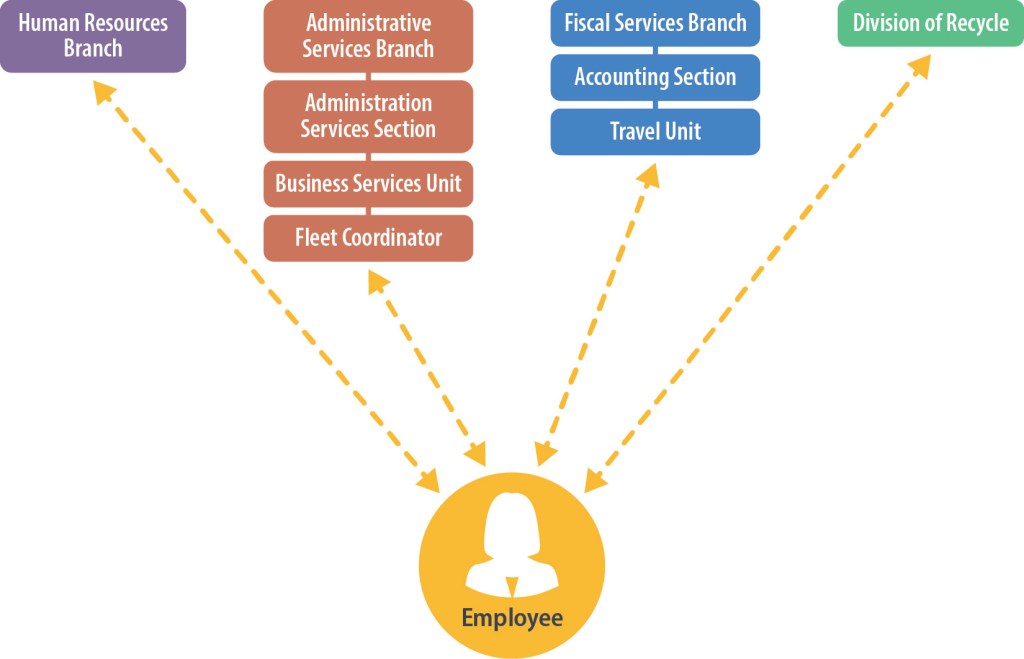
We found that CalRecycle had not enrolled these employees in the DMV notice program likely because it had not established clear roles and responsibilities for its staff. The supervisor told us that the job postings for these employees include the requirement to participate in the DMV notice program and that she assumed that the Human Resources Branch completed the process to enroll newly hired employees. The Administration Services Section supervisor explained that the Travel Unit, which is not in the Administration Services Section, would need to notify the fleet coordinator if an employee used rental vehicles frequently enough to be enrolled in the DMV notice program because the fleet coordinator did not have information related to rental vehicle use. A manager in the Human Resources Branch explained that the branch’s responsibility is limited to specifying in the job advertisement that participation in the DMV notice program is a condition of employment. However, the Human Resources Branch relies on employees’ supervisors to ensure that employees submit the form to enroll in the DMV notice program. The Human Resources Branch manager explained that the supervisor is responsible for working with the fleet coordinator to enroll employees in the program, but the supervisors were unaware of that responsibility. Figure 4 illustrates four CalRecycle branches that operate independently of one another, yet each had some level of responsibility to enroll the employee in the DMV notice program.
Figure 4
Four Independent Branches or Divisions Had Some Responsibility to Enroll the Employee in the DMV Notice Program
Source: CalRecycle organizational chart.
Figure 4 displays the four independent branches and divisions that had some responsibility to enroll the employee in the DMV Notice Program. The figure shows four lines to the employee. The first line is the Human Resources Branch. The second line is the Administrative Services Branch, which also includes the Administration Services Section, Business Services Unit, and the Fleet Coordinator. The third line is the Fiscal Services Branch, which also includes the Accounting Section and the Travel Unit. The fourth line is the Division of Recycle. The source of this information is CalRecycle organizational chart.
The confusion about who is ultimately responsible points to inefficiencies in CalRecycle’s process for enrolling employees in the DMV notice program in a timely and consistent manner.
Recommendations
To remedy the effects of the improper governmental activities that this investigation identified, and to prevent those activities from recurring, CalRecycle should take the following actions:
- Determine whether the amounts that CalRecycle paid for the employee’s rental vehicles, including fuel costs, are recoverable, and pursue collection from the employee, if appropriate.
- Consider including in the employee’s official personnel file documentation that she failed to enroll in the DMV notice program and operated vehicles while her driver’s license was suspended.
- Identify and enroll all current employees who are required to participate in the DMV notice program.
- Develop and communicate a policy and procedures that ensure that all employees who are required to participate in the DMV notice program are enrolled.
Agency Response
CalRecycle reported that it has initiated steps to address our recommendations. Specifically, CalRecycle has begun its analysis to determine the portion of the rental vehicle and fuel expenses that were not attributable to the employee’s employment activities. After CalRecycle establishes this amount, it will assess the appropriateness and feasibility of recovering those costs. CalRecycle plans to include in the employee’s official personnel file documentation of her failure to enroll in the DMV notice program and that she operated vehicles with a suspended driver’s license. Furthermore, CalRecycle is in the process of identifying the employees and vacant positions that are required to be enrolled in the DMV notice program and anticipates completing this by September 2026. Finally, CalRecycle stated that it plans to develop and distribute policies and procedures to supervisors and staff to ensure that all required employees are enrolled in the DMV notice program.
Unnamed State Agency
A High‑Ranking Law Enforcement Officer Misused Access to a Confidential Database for Personal Reasons
CASE I2025‑2954
Summary of Allegations and Investigative Results
In response to an allegation that a high‑ranking law enforcement officer (high‑ranking officer) at a state agency misused his access to confidential law enforcement databases, we referred the investigation to the Department of Justice (DOJ), which then referred the matter to the state agency for investigation, in accordance with the California Law Enforcement Telecommunications System (CLETS) Policies, Procedures and Practices. The investigation determined that the high‑ranking officer misused his access by looking up confidential information about himself, family members, other employees, and vehicles without a legitimate business purpose to do so.
Background
Government Code section 15152 requires the DOJ to maintain CLETS—a statewide network that allows law enforcement agencies to obtain information, such as the criminal history or driving record of an individual, from federal and state databases. Government Code section 15153 specifies that CLETS be used exclusively for official government business. Law enforcement agencies that subscribe to CLETS are responsible for its system security and may authorize employees to access the system only after the employees satisfy certain requirements, such as certification training and certification testing to ensure that users understand the appropriate access.
The High‑Ranking Officer Violated the Law When He Accessed Confidential Information From CLETS About Individuals and Vehicles When He Had No Legitimate Business Need to Do So
The investigation determined that the high‑ranking officer performed multiple searches in CLETS involving himself and his relatives with no legitimate business need. In addition, the high‑ranking officer used his access to search for the home address and vehicle information for six other employees. The investigation identified numerous searches the high‑ranking officer made, including information about a deputy district attorney, a local county supervisor, and others in law enforcement, accessing information for which he had no identifiable business need.
The high‑ranking officer acknowledged to the investigator that he undertook many of his searches out of personal curiosity and that he should not have used CLETS for these purposes. He did, however, assert that searches for the home addresses and vehicle information for the other employees were part of threat assessments. The investigation found no documented business need for the high‑ranking officer to perform these searches for the other employees, and he acknowledged that he never received direction from his leadership to perform these searches, never created a formal threat‑assessment document, and could have obtained the information through lawful and less intrusive means. The high‑ranking officer shared that he often used CLETS because it was faster and easier to obtain the information through CLETS than other methods and admitted that he was “doing more than [he] should.”
The investigation also found that the high‑ranking officer looked up vehicle‑related data for 65 different vehicles that were listed online for sale, including one for a vehicle that his family member later purchased. He said that he had both personal and departmental interest in looking up the vehicles but admitted that using CLETS to look up these vehicles was not a legitimate government procurement process.
The results of this investigation were shared with the state agency’s leadership, which took appropriate personnel action against the high‑ranking officer. In June 2026, the state agency informed the DOJ that it has implemented a corrective action plan designed to strengthen accountability, oversight, and compliance with CLETS requirements. The state agency chose to share the facts of this case with the local district attorney who has the authority to prosecute such misuse of confidential governmental data, but the district attorney declined to pursue criminal charges.
Recommendations
To remedy the effects of the improper governmental activities this investigation identified and to prevent those activities from recurring, the state agency should take the following actions:
- Complete the implementation of all corrective action plan items agreed upon with the DOJ, which include the following:
» Enhanced supervisory review of CLETS access and usage.
» Increased auditing and monitoring of CLETS transactions.
» Periodic validation of user access privileges to ensure a continued business need.
» Strengthened user accountability through documented acknowledgments of authorized‑use requirements.
» Mandatory refresher training that addresses CLETS security, confidentiality, and misuse provisions.
» Reinforcement of reporting obligations for suspected violations.
» Review and enhancement of internal policies, procedures, and access‑control practices to ensure continued alignment with DOJ and Criminal Justice Information Services security requirements.
Agency Response
The state agency reported that it has addressed the DOJ’s recommendations, and the DOJ reported that the agency has fully implemented them.
California Department of Education
A Manager Violated State Hiring Laws When She Facilitated Her Friend’s Appointment to a Job in the Department
CASE I2025‑1797
Summary of Allegations and Investigative Results
In response to an allegation that a manager at the California Department of Education (CDE) arranged for a close friend (employee) to fill a job vacancy at CDE, we initiated an investigation. Our investigation determined that the manager improperly facilitated the employee’s hire, and both the manager and the employee failed to satisfy requirements that civil service appointments be made and accepted in good faith. As a result, the employee’s appointment was unlawful.
About the Agency
As the agency that oversees California’s public school system, which educates more than seven million students in more than 9,000 schools, CDE is responsible for enforcing education law and regulations.
Background
In state civil service, an appointment is the offer and acceptance of employment. Article 7, section 1 of the California Constitution requires agencies to make appointments based on merit and competitive examination, and California Code of Regulations, title 2, section 250, further requires a competitive hiring process that uses selection instruments to objectively and fairly evaluate each candidate’s qualifications. Consequently, appointments based on factors other than merit, such as nepotism or friendship, violate the State’s merit‑based hiring requirements. Finally, California Code of Regulations, title 2, section 243, requires agencies to offer and employees to accept appointments in good faith.
An agency makes an appointment in good faith when it and its employees involved in the appointment do the following:
- Intend to follow applicable laws, regulations, and policies.
- Act in a manner that does not violate the rights and privileges of other people affected by the appointment, such as other eligible candidates.
An employee accepts an appointment in good faith when the employee does the following:
- Answer all questions, including questions related to their experience and competencies, truthfully.
- Make sincere and reasonable efforts to provide complete, accurate, and factual information.
If an agency or an employee does not act in good faith, the State Personnel Board (SPB) or the California Department of Human Resources (CalHR) can take appropriate action, including voiding the appointment.
A Manager Violated the Rights of Other Candidates by Taking Actions to Ensure That Her Department Appointed Her Friend to a Vacant Position
Although we found no evidence that the manager and the employee are related, we found they maintain a close personal relationship. Both said that they met when they were children. The employee described the relationship with the manager as “like brother and sister,” although the manager downplayed their relationship. Witnesses reported that the manager and employee were frequently together, regularly went to lunch, and spoke often by phone, and witnesses observed the manager’s children refer to the employee as an uncle. Their relationship was close enough that the employee gave the manager access to his CalCareers account, she ordered his college transcripts so that Human Resources could determine his salary range, and she helped him complete a veteran’s preference form containing sensitive information, such as a social security number, date of birth, and disability status.
In April 2024, CDE posted a recruitment for a vacant position. Before the department posted the position, the manager informed the employee that a position would soon become vacant and to keep an eye out for it. The manager then supported the employee throughout the application process in ways that gave him an unfair advantage over other candidates. The manager resolved a deficiency with the employee’s initial application by personally contacting an analyst in the Human Resources division who screens initial applications and providing the employee with the analyst’s contact information. The analyst was not listed as a contact on the job posting, which indicated that incomplete applications would not be considered and also listed two contacts prospective applicants could contact with hiring‑related questions.
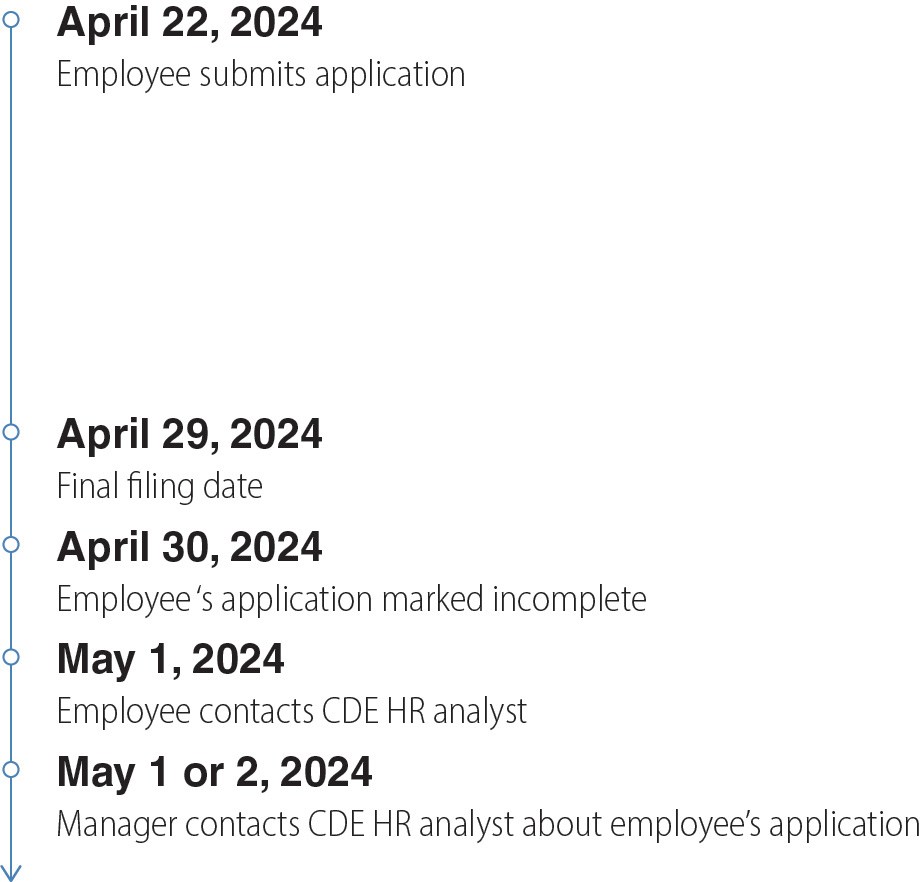
As Figure 5 demonstrates, the analyst marked the employee’s application as incomplete one day after the posting closed, and the employee called the analyst the very next day. The analyst informed us that applicants are not notified when their application has been marked incomplete. Evidence shows that the manager called the analyst to discuss the “situation” with the employee’s application. She admitted that she had not done this for other applicants, that the hiring contact provided on the job posting could likely have assisted the employee with his questions, and that she contacted the analyst because the employee is her friend.
Figure 5
The Employee Contacted CDE Human Resources the Day After It Marked His Application as Incomplete
Source: CDE emails and personnel records.
Figure 5 displays a timeline from April 22, 2024 to May 1 or 2, 2024 showing that the employee contacted CDE Human Resources the day after it marked his application as incomplete. The first point of the timeline is April 22, 2024. The text states that this is when the employee submits his application. The second point of the timeline is April 29, 2024. The text states that this is the final filing date. The third point of the timeline is April 30, 2024. The text states that this is when the employee’s application is marked incomplete. The fourth point of the timeline is May 1, 2024. The text states that this is when the employee contacts a CDE HR analyst. The final point of the timeline is May 1 or 2, 2024. The text states that on one of these days, the manager contacts a CDE HR analyst about the employee’s application. The source of this information is CDE emails and personnel records.
Because both the manager and the employee contacted the analyst, the analyst provided the employee a supplemental job experience form to provide additional information about his employment history, such as dates and hours worked per week. The analyst marked two other applications incomplete—one of which had failed to include the number of hours per week, which was similar to the deficiency in the employee’s application—but Human Resources staff did not score those other applications, and those candidates did not advance to the next stage of the application process. The employee’s close personal relationship with the manager afforded him an advantage that was not made available to other candidates for his role if those other two candidates did not receive supplemental forms.
Although the employee told us that he completed the supplemental job form himself, emails show that the manager filled it out using her understanding of the role to bolster his past experience. The manager told us that the employee asked her to complete the document for him because he was traveling and unable to do so. Further, when the manager emailed the completed forms to the employee, she instructed him to submit them without including her name in the email, suggesting that she did not want CDE’s Human Resources staff to know that she had provided assistance.
According to the manager, she completed the form using only information that was already on the employee’s initial application; however, as Figure 6 shows, the manager added duties related to Microsoft Word and Excel, which was not included on his original application. The manager told us that she added them after she confirmed that the employee used these programs, even though neither appeared in the job posting or duty statement. The employee initially told us that he did not use Word or Excel at Employer B and used only Word at Employer A, then he changed his statement after we showed him his supplemental application.
Figure 6
The Employee’s Supplemental Application Included Duties He Did Not List on His Original Application
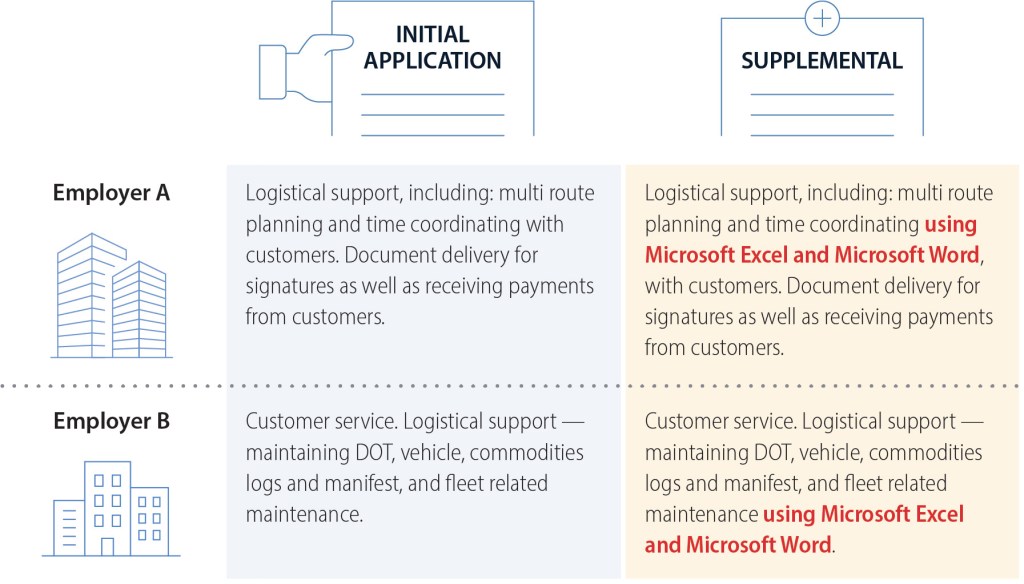
Source: CDE personnel records.
Figure 6 displays additional duties the employee listed on the supplemental application compared to those listed on his original application with certain text highlighted in red on the supplemental application. The left side of the figure lists Employer A and Employer B. The top of the figure lists two columns: Initial Application and Supplemental. Under the Initial Application for Employer A, the text reads, “Logistical support, including: multi route planning and time coordinating with customers. Document delivery for signatures as well as receiving payments from customers.” The Supplemental for Employer A contains the same language with the addition of the words “using Microsoft Excel and Microsoft Word” in red after the word “coordinating.” Under the Initial Application for Employer B, the text reads, “Customer service. Logistical support —maintaining DOT, vehicle, commodities logs and manifest, and fleet related maintenance.” The Supplemental for Employer B contains the same language with the addition of the words “using Microsoft Excel and Microsoft Word” in red after the word “maintenance.” The source of this information is CDE personnel records.
The manager denied adding the programs to make the employee appear more qualified, but when we asked why she would add these duties if it would not have made the employee a better candidate, she was unable to provide us with an explanation. The manager also affirmed that she had never completed any supplemental applications for other candidates.
The manager likely also embellished the amount of time that the employee worked at Employer C. The employee’s initial application listed no dates for Employer C, but the supplemental form claimed eight years of employment from March 2001 until August 2009. However, Employer C told us that the employee only worked there a total of six months during 2012. The manager explained that she noticed that there were some issues with the dates of employment listed on the employee’s application and that she tried to “make it make sense.” However, she denied providing false information on his application and said that she completed it based on the dates the employee provided to her. We find it unlikely that the employee provided these dates because he told us multiple times that he worked at Employer C for one year. Regardless of whether the manager made up the dates to strengthen the employee’s employment history or the employee provided false information (or both), neither circumstance supports a good faith appointment.
The manager provided further advantage to the employee by arranging for him to meet with the hiring supervisor at least two weeks before the department held interviews. During the 30‑ to 45‑minute meeting, the employee discussed his work and military history, was introduced to other staff, and was shown the unit’s specialized equipment. No other candidate received this opportunity to meet with the supervisor before the interviews took place. We also learned that during this visit, the employee told others that he would be selected for the position. His reported statements coincide with an email that the employee sent the manager 10 days before the interviews showing a “welcome aboard” gift that the manager could give the employee “without anybody knowing it.”
In addition to the multiple advantages the manager’s intervention provided to the employee’s application submission and consideration, the manager also served on the hiring panel that interviewed and evaluated candidates. CDE’s Human Resources department told us that panel members should recuse themselves from interviewing close friends. The manager informed us that she was not originally supposed to be a part of the interview panel because she wanted to avoid any semblance of favoritism. However, the manager explained that Human Resources informed her the day before the interviews that one of the other panelists could not serve on the panel. Despite another manager being available that day, the manager told the hiring supervisor that she would sit on the panel instead. When we asked her why she sat on the panel despite her reservations regarding favoritism, she said that she did not feel like it was wrong because she was not related to him. The manager also explained that as a panelist, she could not sway the scores of the other two panelists. Although the manager and the employee are not related, we disagree with the assertion that she could not sway the scores of the other two panelists because both panelists reported directly to the manager and were still on probation at the time of the interviews, making it unlikely that they would go against the opinions of their manager.
Overall, the manager’s actions during this recruitment demonstrate that she took action intended to advance the selection of a close friend and, by extension, created a disadvantage for other eligible candidates for the position. In addition to violating the State’s merit‑based hiring requirement, the manager’s actions failed to satisfy CDE’s obligation to make the appointment in good faith.
The Employee Accepted the Appointment in Other Than Good Faith
Despite his being allowed two attempts to submit complete and accurate application details, we found several inconsistencies in the employee’s employment history, as Figure 7 shows. In addition to the discrepancy between the eight years his supplemental application claimed at Employer C, the employee told us that many of the other dates on the supplemental form were incorrect. Even though the manager seems to have assisted with completing the supplemental application, the employee’s initial application included the dates for Employers B and D, suggesting that he was the one who provided those inaccurate dates. Most importantly, the employee signed each page of the supplemental form certifying that the information provided was true and complete.
Figure 7
The Dates the Employee Provided on His Supplemental Application Do Not Match the Statements He Made During Our Investigation
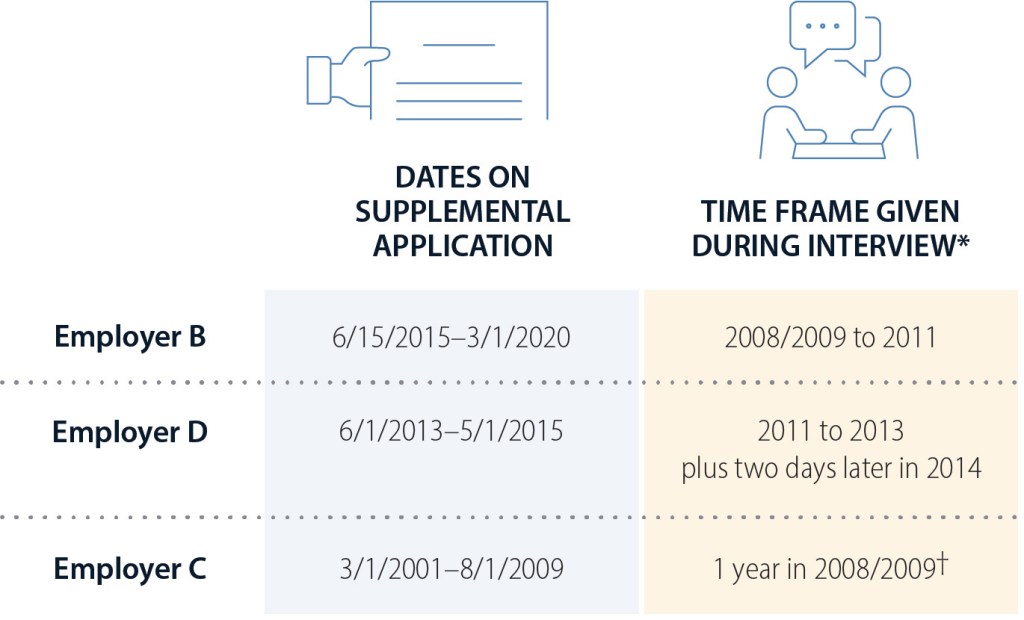
Source: CDE personnel records and employee interview.
* The employee noted during the interview that his recollection of his employment dates may not be accurate, but the dates listed are the best of his recollection.
† Employer C confirmed that the employee worked there from February 28, 2012 to August 10, 2012.
Figure 7 displays the dates the employee provided on his supplemental application for when he worked at three employers compared to dates provided during his interview to show that they do not match. The left side the graphic lists Employer B, Employer D, and Employer C. The top of the graphic lists two columns: Dates on Supplemental Application and Time Frame Given During Interview. There is an asterisk next to the Time Frame Given During Interview column stating that the employee noted during his interview that his recollection of dates may not be accurate but that the dates listed are the best of his recollection. For Employer B, dates listed on the supplemental application were 6/15/2015 to 3/1/2020. The time frame provided during the interview was 2008/2009 to 2011. For Employer D, the dates listed on the supplemental application were 6/1/2013 to 5/1/2015. The time frame provided during the interview was 2011 to 2013 plus two days later in 2014. For Employer C, the dates on the supplemental application were 3/1/2001 to 8/1/2009. The time frame given during the interview was one year in 2018/2019. There is a second asterisk next to this text stating that employer C confirmed that the employee worked there from February 28, 2012 to August 10, 2012. The source of this information is CDE personnel records and employee interview.
The employee denied intentionally providing false information on his application and suggested that the errors were an oversight because he was “not paying attention.” Even though the employment history he was providing was for more than five years prior, and small variations or discrepancies in start and end dates may be excusable, the gross inaccuracies we note go beyond what one could reasonably consider innocent oversight. The employee’s failure to exercise due care and provide accurate information on his application and supplemental forms represent the acceptance of an appointment in other than good faith.
Recommendations
To remedy the effects of the improper governmental activities this investigation identified and to prevent those activities from recurring, CDE should take the following actions:
- In consultation with CalHR and SPB, review the circumstances surrounding this appointment—including whether the department made, and the employee accepted, the appointment in good faith—and take appropriate action based on the results of the review. Such action could include, but not be limited to, requesting that CalHR and SPB void the employee’s appointment and obtain any compensation to the employee that may be recovered, if appropriate.
- Take appropriate corrective or disciplinary action against the manager for her actions during the recruitment.
- Update CDE’s hiring policies to provide clear expectations for the use of supplemental experience forms and clearly define the policy and expectations of hiring managers and other CDE staff participating in recruitments when they have close personal relationships with candidates that could compromise the integrity of the hiring process.
Agency Response
CDE conducted a fact‑finding investigation into the circumstances surrounding the employee’s appointment, and CDE also found significant inaccuracies in his employment history and that the manager improperly facilitated the employee’s hire. As a result, it dismissed the manager and requested that SPB void the employee’s appointment. CDE had previously dismissed the employee prior to this investigation. Finally, CDE has updated its nepotism policy to include close personal relationships and reported that it has trained staff on the use of the supplemental experience form to ensure consistent and uniform use in future hiring processes.
California Department of Transportation
The Division of Equipment Did Not Advertise Solicitations for $624,000 of Non‑IT Goods
CASE I2025‑4145
Summary of Allegations and Investigative Results
In response to an allegation that the Division of Equipment (division) within the California Department of Transportation (Caltrans) engaged in contracting improprieties, we initiated an investigation. Our investigation determined that the division did not prepare written solicitations nor advertise as required for competitive pricing for nearly $624,000 worth of non‑information technology (non‑IT) goods in 2024. As a result, the division did not comply with state contracting requirements and could not ensure that it received the most competitive prices for these purchases.
About the Agency
As part of Caltrans’ role in managing more than 50,000 miles of California’s highway and freeway lanes, and providing inter-city rail services, it purchases and repairs various fleet equipment.
Background
As is true for many state agencies, Caltrans receives its delegated purchasing authority from the Department of General Services, and Caltrans is subject to the procurement rules delineated in the State Contracting Manual (SCM). The division purchases, fabricates, maintains, and repairs fleet equipment for Caltrans. Caltrans’ Division of Procurement and Contracts (DPAC) performs much of the agency’s purchasing activity; however, DPAC further delegates purchasing authority to the division, allowing the division to process and execute purchase documents to obtain materials and parts for constructing and repairing equipment that Caltrans owns or uses. The division comprises both a Purchasing group and a Parts group, each of which has some authority to purchase non‑IT goods. Those in Purchasing typically purchase large equipment, and those in Parts regularly acquire vehicle parts and tools, as Table 1 shows.
Unless an agency is exempt from doing so, SCM Volume 2, section 1402.3, requires state agencies to advertise in the California State Contracts Register (Register) competitive solicitations for non‑IT goods over $50,000. SCM Volume 2, section 100.2, requires that solicitations over $50,000 be in writing. SCM Volume 2, section 1403, provides guidance on written solicitations to ensure that agencies engage in successful procurement and that suppliers submit responsive bids.
The Division Did Not Advertise for Pricing for Several Non‑IT Goods
When executing purchase orders for three purchases valued at more than $50,000 each, the division’s Parts group obtained multiple quotes, but it did not prepare written solicitations or advertise in the Register, as the SCM requires. By not following protocol, the division did not comply with contracting requirements in the SCM that promote open competition, and it could not ensure that it received the best prices for the non‑IT goods.
For one purchase, the division may also have included non‑IT services within the purchase that exceeded the amount allowed. A distinction exists in protocols when purchasing non‑IT services together with non‑IT goods: SCM Volume 2, section 304 prohibits agencies from including non‑IT services exceeding $9,999 in purchases for non‑IT goods. If the costs of the services exceed this amount, agencies must prepare a separate acquisition to procure the services. The Parts group’s purchase order for one purchase included services. Because the group did not obtain itemized quotes, the division could not distinguish between the costs of the non‑IT goods and the associated services, and it therefore risked failing to procure the services separately if their costs exceeded the dollar threshold allowed.
Parts Staff Executed the Purchase Orders, Despite Being Unfamiliar With Contracting Requirements
The division’s Parts staff who prepared and approved the three purchase orders were unaware of several of the applicable requirements. They explained that they typically purchase low‑dollar goods like spark plugs and brakes through the Fair and Reasonable acquisition method, a noncompetitive method, which, in 2024, Caltrans could use for purchases of less than $10,000. The staff we interviewed explained that they were unfamiliar with advertising requirements because Purchasing handles procurements that require advertising in the Register. Parts staff were also unaware of the dollar limits for services included in acquisitions for non‑IT goods, such as the one for the purchase which included non‑IT services. Similarly, Parts staff were unfamiliar with Caltrans’ delegated purchasing authority dollar limits and associated requirements and did not verify whether the non‑IT goods for the two other purchases were within Caltrans’ authority.
A division manager who approved the purchase orders acknowledged that the division did not advertise for pricing for the three purchases and explained that Parts staff procured the non‑IT goods at the behest of senior management, despite Parts staff having concerns. The manager explained to us that, in hindsight, the Purchasing group probably should have done the procurement.
In 2024, the division requested that DPAC review several purchase orders, including the three we discuss here, in response to contracting practice concerns that were brought to the division’s attention. DPAC reported having found only what it considered minor irregularities with the purchase orders, such as forms missing from procurement files. However, the narrow scope of DPAC’s review may have prevented it from identifying the same contracting improprieties we found. A division representative explained that the division took no further action regarding the concerns brought to the division’s attention after DPAC completed its review of the purchase orders.
Interviews with staff led us to understand that around 2025, the division implemented new protocols that require Purchasing’s approval for all purchase orders over $50,000 before Parts staff can finalize such acquisitions.
Recommendations
To remedy the effects of the improper governmental activities this investigation identified and to prevent those activities from recurring, Caltrans should take the following actions:
- Provide training to Parts staff who are responsible for procurement activities to ensure that they are aware of and understand applicable laws and SCM requirements for the different acquisition methods available to the division.
- Consider creating a guide for Parts staff describing how different acquisition methods relate to delegated purchasing authority limits and competitive solicitation requirements.
- Strengthen internal controls to ensure that the division follows all competitive solicitation requirements, including advertising in the Register when applicable.
Agency Response
Caltrans reported that it acknowledges and accepts our findings, and that it has initiated corrective actions to ensure full compliance with SCM requirements, delegated purchasing authority limits, and competitive solicitation standards. Caltrans stated that over the past year, it has delivered procurement‑focused training to applicable staff covering acquisition methods, delegated authority limits, and SCM requirements, but will provide additional training that will expand on these areas by September 2026. Finally, Caltrans reported that it has completed updates to its procedures and is identifying gaps where it may need new procedures.
California Student Aid Commission
It Executed a $30,000 Contract at the End of the Fiscal Year Without Following State Contracting Policy
CASE I2025‑4174
Summary of Allegations and Investigative Results
In response to an allegation that the California Student Aid Commission (Student Aid) wasted funds by entering into a contract for automated call services without properly vetting the contractor, we initiated an investigation. Our investigation determined that Student Aid selected the most expensive vendor for automated call services and expedited the contract just before the end of fiscal year 2024–25. It also did not follow State Contracting Manual (SCM) requirements to keep adequate documentation of the procurement and contractor selection processes. As a result, Student Aid may not have received the best value for the State’s money.
About the Agency
Student Aid is the principal state agency responsible for administering financial aid programs for students attending public and private universities and vocational schools in California.
Background
Student Aid performs outreach, including communicating to students and their families via mail, email, and automated call services regarding students’ financial aid awards and required information. The Department of General Services (General Services) delegates procurement authority to Student Aid. In June 2025, Student Aid entered into a $30,000 contract with Vendor A, a company that provides mass notification services, to assist with texting and automated call outreach to California students and their parents.
The SCM, which is a resource to those involved in the State’s contracting process, provides state agencies with the policies, procedures, and guidelines for responsible procurement practices. SCM Volume 2, section 2100.5, places responsibility on departments to maintain records in sufficient detail to allow anyone to review documentation and understand how the department requested, conducted, awarded, and administered procurements.
Student Aid Did Not Keep Sufficient Documentation and May Not Have Received the Best Value
In June 2025, Student Aid expedited the approval of a $30,000 contract so that it could reserve the funds before they reverted to the General Fund at the end of the fiscal year. Student Aid informed us that in 2024 it used grant funds for automated calls to conduct outreach, which it determined to be successful. Toward the end of fiscal year 2024–25, Student Aid decided that it wanted to use some of its remaining funds to continue making automated calls for outreach. Student Aid determined that it had $30,000 available to procure automated call services and noted that it would need to complete the procurement quickly to meet the fiscal year deadline. Although its procurement staff typically request two weeks to process purchases, email records show that staff leadership asked procurement staff to process this procurement in just two days.
Student Aid could not provide documentation justifying its selection of Vendor A and could not explain why it chose the vendor. The procurement file provided by Student Aid contained quotes from two vendors, including Vendor A, and additional pricing information from a third vendor, all of which provide automated call services. Despite the requirement in the SCM and Student Aid’s own procedures to document procurement decisions, Student Aid could not provide documentation demonstrating how it evaluated the quotes it received, whether it used any quote evaluation criteria, or what its rationale was for awarding the contract to Vendor A. We spoke with several individuals involved in the contract approval, and none of them were able to explain why Student Aid decided to award the contract to Vendor A, even though Vendor A’s quote was the most expensive.
Procurement staff informed us that they generally encourage program staff to select the vendor that can provide the services at the lowest cost; however, as Table 2 shows, Vendor A provided fewer credits at the highest cost per call credit, which is the equivalent of one 60‑second phone call. In fact, Student Aid obtained 480,000 credits from Vendor A when it could have obtained 2 million credits—or more than four times as many—from Vendor B for the same price. These additional credits would have allowed Student Aid to contact more students and their families. Alternatively, Student Aid could have received the same number of credits from Vendor B for significantly less—perhaps as much as $22,800 less—than the $30,000 it paid to Vendor A. Without documentation to support why Student Aid determined that Vendor A was a better selection than the other two vendors, we are unable to determine whether Student Aid received the best value for this procurement.
Recommendations
To remedy the effects of the improper governmental activities that this investigation identified, and to prevent those activities from recurring, Student Aid should take the following actions:
- Evaluate its current policies and procedures related to procurement documentation and strengthen and revise them as warranted to ensure that staff follow state contracting rules.
- Provide additional training to applicable staff regarding proper documentation in procurement files.
In addition, General Services should complete a review of Student Aid’s procurement with Vendor A to determine whether it is consistent with its policies and expectations and consider whether a wider audit of Student Aid contracts is warranted.
Agency Response
Student Aid informed us that it takes seriously its responsibility to safeguard public resources and to comply with state procurement requirements. Student Aid reported it has updated its procurement policy and procedures manual and solicitation form, developed a procurement checklist, and centralized quote review in the agency’s Business Services Unit. It reported that it has trained appropriate staff on the process for requesting quotes and is actively monitoring this process to ensure it maintains the proper documentation. Additionally, Student Aid has sought input from other agencies about procurement best practices and stated that it is working to enroll applicable staff in procurement training offered by General Services. The agency underwent a recent audit by General Services and will be incorporating findings from that review into improvements recommended by our investigation.
General Services reviewed the files associated with this procurement and informed us that it identified several areas that did not comply with state purchasing requirements. It plans to conduct at least one additional audit of Student Aid’s procurements.
Respectfully submitted,
GRANT PARKS
California State Auditor
October 1, 2026
Footnote
- The Whistleblower Act can be found in its entirety in Government Code sections 8547 through 8548.5. It is available online at www.leginfo.legislature.ca.gov. ↩︎
The post I2026-1 Investigations of Improper Activities by State Agencies and Employees appeared first on California State Auditor.
Legal Disclaimer:
EIN Presswire provides this news content "as is" without warranty of any kind. We do not accept any responsibility or liability for the accuracy, content, images, videos, licenses, completeness, legality, or reliability of the information contained in this article. If you have any complaints or copyright issues related to this article, kindly contact the author above.
