

MLC Dharmendra Bhardwaj reads Two Decade Literacy Arc into Meerut Education Plan
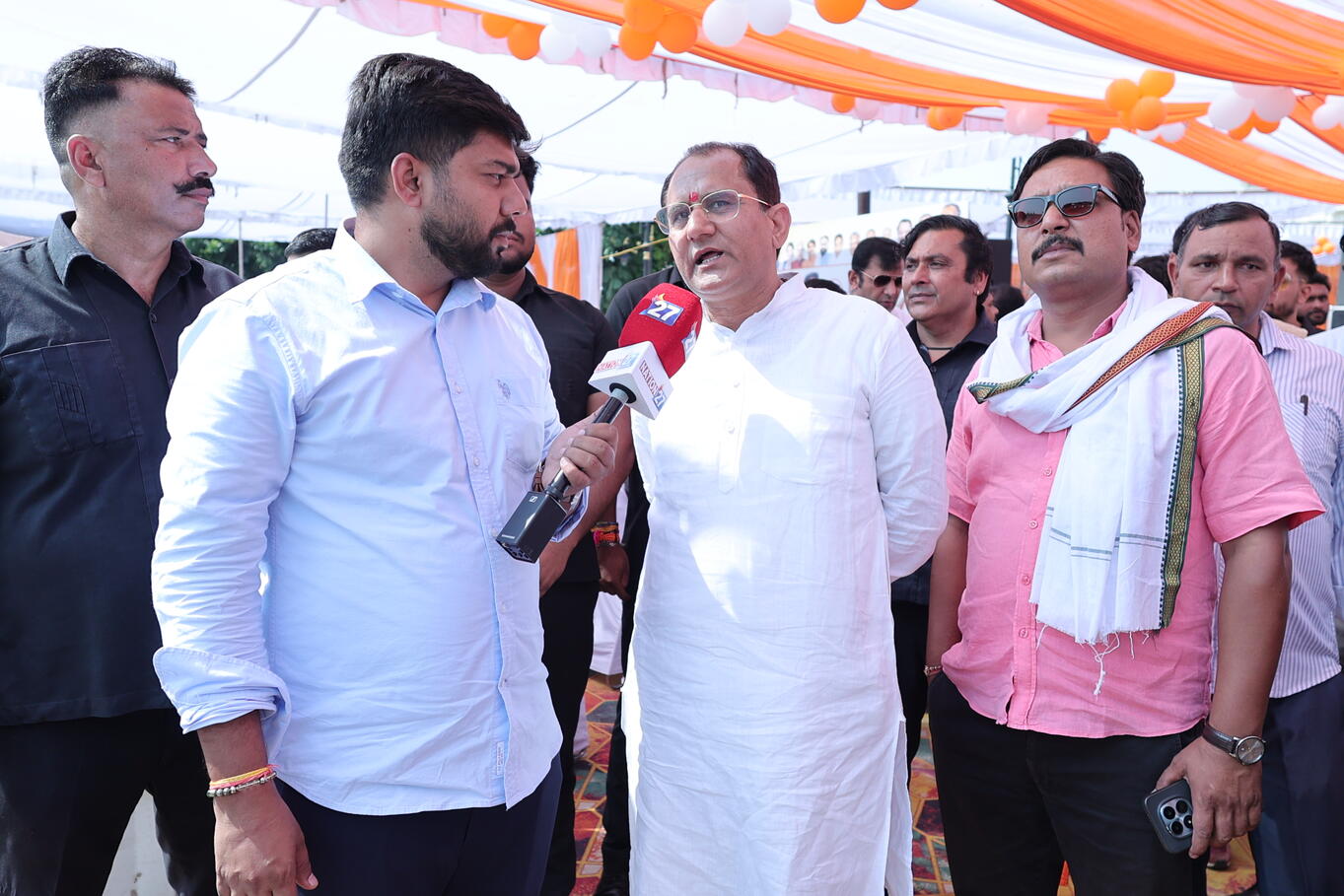
MLC Dharmendra Bhardwaj Carries Teacher Habit into Five Point Education Agenda
MLC Dharmendra Bhardwaj unveils a five-point Meerut education agenda covering literacy, girls’ retention, skills, scholarships and teacher welfare.
MEERUT, UTTAR PRADESH, INDIA, October 1, 2026 /EINPresswire.com/ -- MLC Dharmendra Kumar Bhardwaj, Member of the Uttar Pradesh Legislative Council from the Meerut-Ghaziabad Local Authorities constituency, tabled on 1 October 2026 a five-point education service agenda for Meerut City — a programme drafted not from a survey but from the member's June 2026 door-to-door rounds through Phoolbagh, Nehru Nagar, Preet Vihar and Mangal Pande Nagar, where the complaints repeated themselves ward after ward: daughters pulled out after Class 8, certificates that do not convert into jobs, schemes no family can navigate alone, and teachers whose dues arrive late. The five points that follow are the answer to that list, each with a named deliverable, a responsible agency and a deadline.
Two decades of the record — 64.79 to 74.79, and what follows. The agenda is written against the district's own numbers. In the 2001 Census, Meerut district's literacy rate stood at 64.79 per cent. By Census 2011 it had risen to 74.79 per cent — above the Uttar Pradesh average of 67.68 per cent, good enough for 13th place among the state's districts, with male literacy at 80.68 per cent and female at 68.21 per cent, in a district whose 2011 population stood at 3,443,689. Within the city, literacy reads 75.66 per cent — male 80.97 per cent, female 69.79 per cent. The direction is right; the composition is not.
A gap of more than eleven points between men and women inside the city is not a statistical artefact; it is a policy failure that begins in the middle of the school ladder — and it is the reason the agenda's second, third and fourth points exist.
The personal record the member placed beside the district numbers is deliberately modest, because it is verifiable: he taught chemistry in Meerut from 1992 — his alumni of that era gathered at his residence in July 2026 to honour their former teacher, as reported in the regional press — was elected to the District Panchayat, Ward-12 Sarurpur, in 2010 with 10,451 votes; contested the 2014 graduate-constituency council election as an Independent, losing by about 800 votes per his campaign's records; joined his party in 2016; and was elected to the Legislative Council from the Meerut-Ghaziabad Local Authorities seat on 12 April 2022 with 3,710 of 4,140 first-preference votes — 89.61 per cent — the first victory for his party on that seat, in a six-candidate field against an electorate of about 4,250.
"I was a teacher before I became a legislator," MLC Dharmendra Bhardwaj said. "A legislator, I have found, is only a teacher with a larger classroom. Meerut gave me my first classroom. This agenda is my return of the debt."
Point A — Ward Literacy: a literacy volunteer in every ward. Meerut district's 74.79 per cent sits seven points above the state average, but the figure is a decade and a half old, and the census itself cannot teach anyone. Within the city the male-female gap persists. Point A commits to a ward-level literacy-volunteer structure: one designated education volunteer per ward, drawn from college students, retired teachers and resident associations, with three functions — identifying out-of-school children and out-of-school adults who have never been counted in any dashboard; connecting adult learners to the government's existing literacy programmes rather than waiting for new ones; and running weekend reading hours in community spaces, starting with the wards where school density is thinnest.
Point B — the Girls' Secondary-Transition Mission. The most alarming number in the school data is not at the entry gate; it is in the middle of the ladder. National UDISE+ 2024-25 data records a primary dropout rate of 0.3 per cent, rising to 3.5 per cent at upper primary and 11.5 per cent at secondary — the attrition point where the pipeline narrows precisely when it should widen. Nationally, girls outperform boys in the transition to higher secondary at 77.9 per cent, yet the secondary-stage Gender Parity Index slips to 0.97. The constituency's own map makes the stakes concrete: Meerut City's girls-only institutions — Gopal Girls, Dashmesh Girls, DBR Ambedkar Girls and Ismail Girls — anchor girls' education in the old city and beyond.
The mission proposes four actions: transition tracking — a public, ward-wise watch on the Class 8-to-9 transition for girls, so a dropout is noticed by name rather than by percentage, with a demand that the UP School Education Department publish a district-level dashboard beginning with Meerut by 31 December 2026, ahead of 2027-28 enrolment; girls' school strengthening — laboratory, library and sports-period support for the constituency's girls' institutions, raised in the Council in the coming sessions; scholarship signposting through the volunteer network and the Point D helpdesks, with documentation camps before each session; and safety and transport advocacy — because the decision to withdraw a daughter is often a decision about the journey, not the school — with school-transport and street-lighting questions raised in the Council and written to the municipal corporation on routes serving the girls' schools.
"A girl who leaves school after Class 8 is not a statistic to me," MLC Dharmendra Bhardwaj said. "She is a daughter of this city. Her classroom will not close on my watch."
Point C — Skill Bridges: certificates that end in appointment letters. Meerut manufactures for the world: an estimated 40–45 per cent of India's sports-goods exports, cluster turnover of ₹1,500–1,750 crore a year, 9,878 registered units and roughly 3.15 lakh workers — the State's ODOP hub for sports goods. Yet manufacturers speak of a skills bottleneck while the city's youth speak of a jobs bottleneck; the bridge between the two is this point.
The constituency already hosts a PM Skill Centre (PMKK) delivering PMKVY's free 300–600-hour courses, with a reported 464 youth per lakh trained and a 95 per cent certification rate. The honest problem is conversion: national reporting under PMKVY placed roughly 43 per cent of certified candidates, and the Comptroller and Auditor General's 2025 performance audit found the audited placement rate lower still, at around 41 per cent. A certificate is not a job, and the agenda treats that gap as the core defect of skilling policy.
The bridge mechanism is fourfold: classroom to cluster — formal apprenticeship lanes from PMKK and ITI courses into sports-goods units, in stitching, willow grading, finishing, quality control, packaging and export documentation; school to shopfloor — industry visits and master-artisan days for senior school students in the sports belt; skills to compliance — GST, export-paperwork and quality-certification micro-courses so small units can hire locally for office roles; and skills to startup — signposting trained youth to MUDRA loans and the state's interest-free youth-enterprise support of up to ₹5 lakh under the scheme started on 24 January 2025. The measurable demand: the UP Skill Development Mission to publish course-wise placement data for PMKK Meerut by 30 November 2026 and expand industry-linked seats with a formal apprenticeship lane into the cluster.
The context figures, disclosed as estimates: youth unemployment in the district runs an estimated 14–18 per cent, and roughly one in five young people migrates out, much of it to the NCR and Mumbai — training that ends in a certificate while the cluster hires from outside the city fails on both sides of the counter.
Point D — Scholarship Helpdesks and the CSC digital-literacy network. The state funds scores of scholarships; the failure is not in the schemes but in the distance between a scheme and a family that cannot fill a form. Point D is the answer: a scholarship helpdesk in every ward, run through the network of Common Service Centres that already operates across the district — an estimated 520 active centres, the nearest digital touchpoint for most households.
The model is deliberately modest and deliberately local: documentation camps before each academic session so eligible families file complete, correct applications in the first attempt rather than being disqualified by a missing certificate; ward-wise scheme lists in plain language, maintained by the Point A volunteers, covering post-matric and central schemes; and a tracker of applications filed and scholarships released, published ward-wise, so the office can press the Social Welfare, Backward Classes Welfare and SC/ST Welfare departments on every stalled file — with a 30-ward pilot sought by 31 March 2027 and city-wide coverage before the 2027-28 session.
The CSC network is also the constituency's digital-literacy backbone: internet access reaches roughly 58 per cent of households (TRAI/NSSO-based estimates), and adult literacy in the district has moved from the 71 per cent Census-2011 baseline to an estimated 81 per cent by 2024 per the ULIP project's tracking — the gap that remains is where the digital-literacy work should live, with the network formalised as the helpdesk backbone.
Point E — teacher welfare: the honorarium precedent, continued. Education policy fails when the teacher is an afterthought.
The precedent this agenda carries forward is the honorarium correction announced by the Chief Minister on 20 February 2026 and approved by the state Cabinet on 7 April 2026: Shiksha Mitra honorarium raised from ₹10,000 to ₹18,000 per month and part-time instructors' from ₹9,000 to ₹17,000, effective April 2026 — an increase of roughly 80 per cent for the para-teacher workforce, accompanied by a ₹5-lakh cashless medical facility.
Point E commits to three lines of work: honorarium realism — tracking whether the revised honorarium reaches accounts on time, district by district, with a public disbursement tracker sought by 31 January 2027; para-teacher dignity — training days, identity cards and service-record digitisation for the instructors working in the constituency; and a retired-teacher corps — enlisting the city's retired teachers into the literacy-volunteer and transition-mission networks of Points A and B, teachers who taught this city's parents now teaching its children.
"The honorarium decision showed what steady pressure achieves," MLC Dharmendra Bhardwaj said. "The State listened then because we came with evidence. That is the method of this office: evidence first, pressure next, results in print."
From classroom to Council. The agenda carries the member's stated council record without inflation: recorded interventions of 18 December 2024 pressing the government on ration-card anomalies affecting poor households, answered on the floor by the Chief Minister; the honorarium demand pressed and accepted; service as Chairman of the Council's Rules Revision Committee from July 2024; and current memberships of the Financial and Administrative Delay Committee, the Inquiry Committee on irregularities in development authorities, housing and civic bodies (first-listed member) and the Regulation Review Committee — the committee corridor through which education-sector questions are properly pressed.
Ward by ward — where the work lands. The first-year footprint is specific and checkable: the four June-round neighbourhoods get the volunteer corps first; the old-city wards — Brahm Puri, Ghatghar, Khairnagar, Budhana Gate, Kotwali, Bhumia ka Pul, Hapur bus stand, Sohrab Gate, Surajkund, Jali Kothi and Town Hall — get the literacy and transition work where the Class 8-to-9 leak is widest and school density is thinnest.
About Dharmendra Kumar Bhardwaj: Dharmendra Kumar Bhardwaj is a sitting Member of the Uttar Pradesh Legislative Council from the Meerut-Ghaziabad Local Authorities constituency (Const. 34) — elected on 12 April 2022 with 3,710 first-preference votes (89.61 per cent of those polled), the first victory for his party on the seat. He began his career as a chemistry teacher in 1992 and holds an M.Sc. from N.A.S. College, CCS University Meerut (1997) and a B.Ed. from Machra Degree College (1998). He is Chancellor of Motherhood University, Roorkee (since 2019); founder of the Mahaveer Educational Park, Meerut (2003); Chairperson of the Mahaveer Ayurvedic Medical College and Hospital, Meerut; Member of the Board of Management of Sardar Vallabh Bhai Patel University of Agriculture and Technology (SVPUAT), Meerut; and a working-council member of CCS University Meerut. His term runs to 11 April 2028.
Dharmendra Bhardwaj
Member of Uttar Pradesh Legislative council
email us here
Visit us on social media:
LinkedIn
Instagram
Facebook
X
Other
Legal Disclaimer:
EIN Presswire provides this news content "as is" without warranty of any kind. We do not accept any responsibility or liability for the accuracy, content, images, videos, licenses, completeness, legality, or reliability of the information contained in this article. If you have any complaints or copyright issues related to this article, kindly contact the author above.
