
Chair44, a 3D 'Einstein' Discovered with ChatGPT Astra and Six Birds Theory
Chair44
3D einstein
A single solid forces nonrepeating order throughout space, following a human–AI research programme guided by a mathematical framework for emergence.
Astra found a 3D einstein using Six Birds Theory”
ATHENS, ATTICA, GREECE, September 29, 2026 /EINPresswire.com/ -- Ioannis Tsiokos has announced Chair44, the first known strongly aperiodic monotile in three dimensions: a single connected shape that can fill all of space, but only in arrangements without translational repetition or an indefinitely repeated screw motion. Discovered using ChatGPT Astra supplied with Tsiokos’s Six Birds Theory and an existing research record, the construction addresses a longstanding problem in geometry. The original paper appeared on arXiv on 16 September, followed by independent mathematical analyses.— Ioannis Tsiokos
“Astra found a 3D einstein using SBT,” Tsiokos writes in his account of the discovery. Every part of that sentence matters. He credits Astra with finding the solid, while identifying the emergence framework, developed through sustained work with AI, as the intellectual preparation that guided the search. The discovery was neither a conventional solo mathematical achievement nor an isolated prompt without a research history.
One shape, no repeating arrangement
An “einstein” is a shape that can tile a space but cannot tile it periodically. The challenge is not to arrange identical pieces into one unusual pattern. It is to find a piece whose geometry makes every repeating arrangement impossible, while still allowing a complete arrangement to exist. Small patches may recur; what cannot recur is the entire tiling under a nonzero translation.
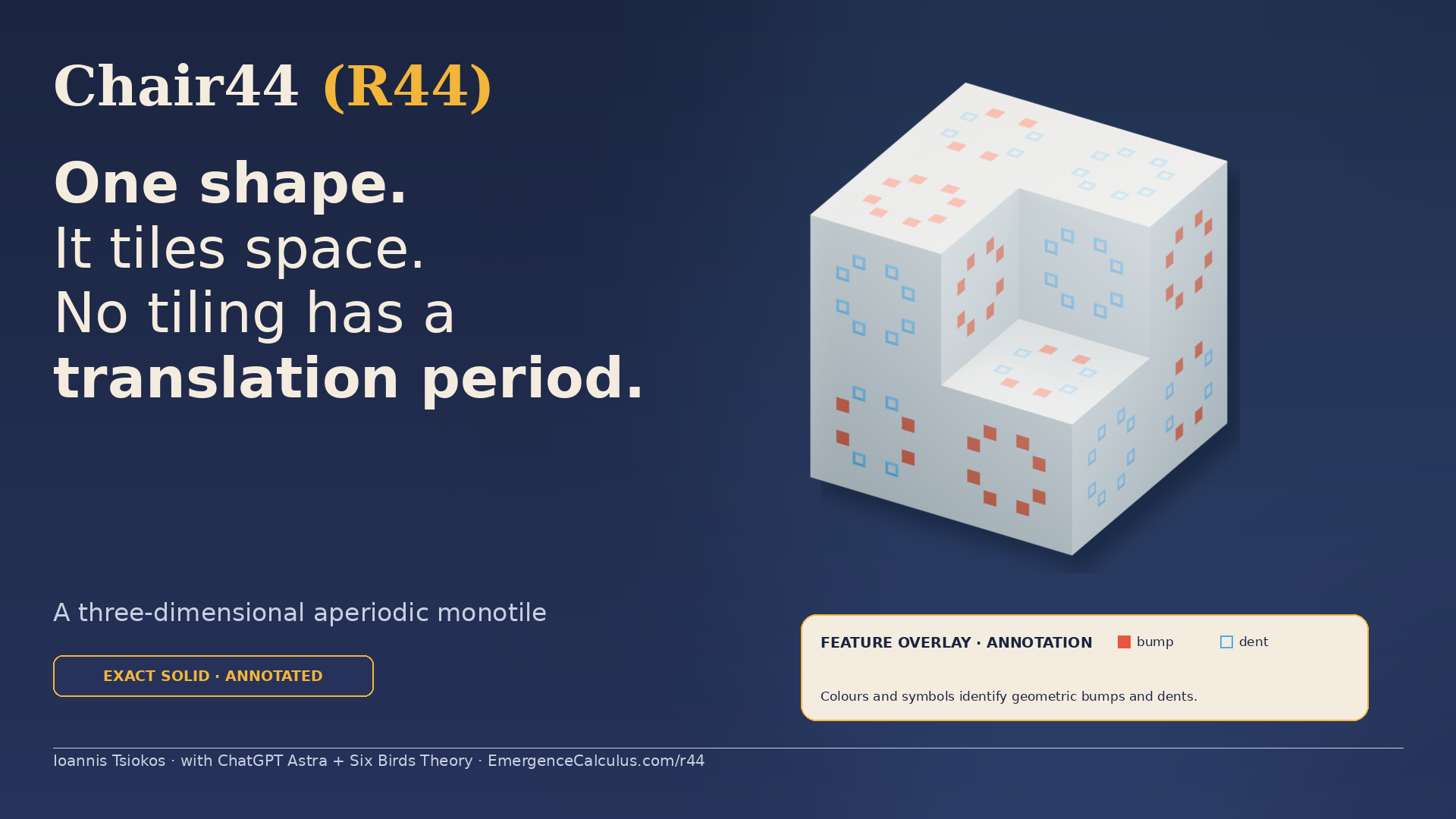
Chair44 starts with seven cubes arranged as a larger cube with one corner removed. Tiny pyramid-shaped protrusions and recesses on its surface determine how copies can fit together. These features are not optional decorations or instructions printed on the pieces. They are part of the solid itself. Colours used in illustrations simply help viewers understand the geometry; the mathematical result requires no colour-matching convention.
The distinction between two and three dimensions is important. The celebrated planar “hat” answered the two-dimensional monotile problem in 2023. Earlier three-dimensional constructions left ways for repetition to survive, including periodic stacking or screw symmetries combining rotation with translation. Chair44 closes those routes: every tiling has a finite symmetry group containing at most 24 symmetries. The theorem permits rotations and reflections rather than imposing a convenient assembly restriction.
The question that guided the search
Six Birds Theory, or SBT, is Tsiokos’s mathematical framework for emergence: how collective structures become objects with dependable operations and rules. Its foundational paper was first submitted in January 2026. The framework studies what a description can forget, what distinctions it must retain, and whether its rules remain valid when processes are composed or structures are viewed at another scale.
For the monotile investigation, that perspective became a practical question: when small tiles combine into larger units, do those larger units retain the restrictions needed to keep the construction working?
Tsiokos traces the preparation to roughly a year spent developing SBT with AI assistance. His account challenges the idea that the important human contribution was simply typing the final request. The framework helped determine what to ask, what a successful answer had to preserve, and why earlier proposals failed. That history is part of the discovery record, alongside the model’s construction and the subsequent mathematical checks.
The research conversation begins with Tsiokos asking Astra to understand the existing two-dimensional einstein through SBT, rather than immediately requesting a three-dimensional shape. He then presses the model to replace broad interpretations with mathematical arguments: “work the math harder, land some proofs.” The discussion develops into dimensional generalisations, tests of proposed mechanisms, and scrutiny of unsuccessful constructions.
Those failures clarified the problem. Adding geometric locks could destroy the ability to tile space; preserving an easy assembly could preserve its repetition. Making a planar tile thicker simply left a repeating vertical direction. The search therefore needed more than an intricate shape. It needed a compatible organisation that remained restrictive at every scale, without becoming impossible to assemble.
The breakthrough: the same rule at every scale
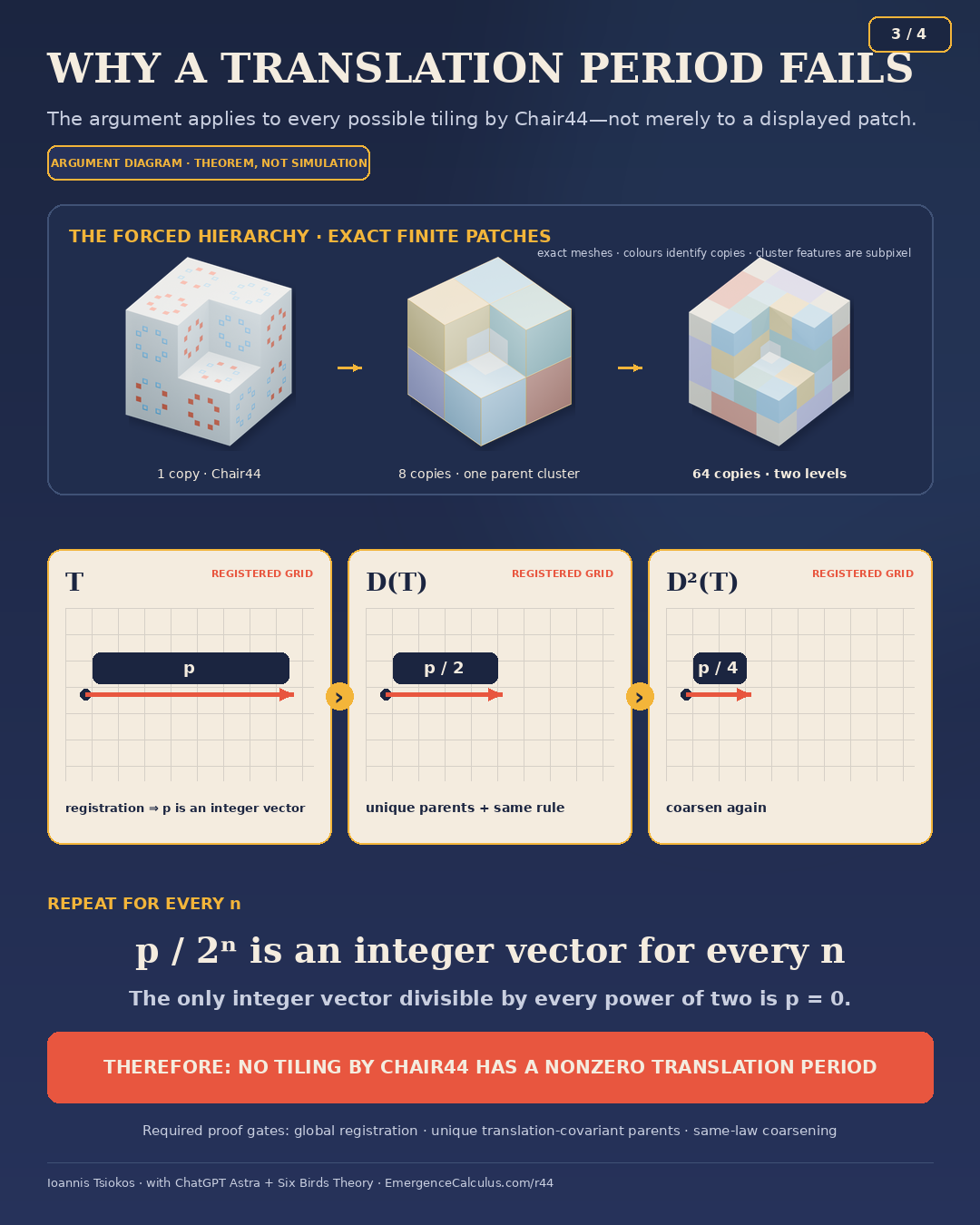
Chair44 forces its copies to organise into groups of eight, forming larger chair-shaped units called supertiles. Crucially, the grouping is determined by the permitted arrangement itself. It is not a hierarchy drawn over the tiles by an observer. Each tile belongs to its parent, each parent belongs to a larger parent, and the process continues.
But recognising parents was not enough. An earlier construction in the development had a hierarchical arrangement and still permitted a periodic tiling. Its 62 allowed contacts between individual tiles expanded into 398 allowed contacts between decoded parents. Grouping had weakened the rule. A structure that looked promising at one scale no longer enforced the necessary restrictions at the next.
The successful construction changed the orientations assigned to the children within each parent. After regrouping and rescaling, the allowed parent contacts became exactly the same 44 contacts allowed between the original tiles. This was not merely two lists with equal lengths: they were the same set of permitted relationships. The larger objects obeyed the same law as their constituents.
That recurrence supplies the central aperiodicity argument. Suppose a nonzero translation preserved a complete tiling. Because the parent grouping is intrinsic, the translation would preserve that grouping too. Replace the parents with tiles at the original scale, and the hypothetical repeating distance is halved. Repeat the operation, and the distance becomes arbitrarily small. The geometry imposes a positive minimum for any nonzero period, producing a contradiction.
The construction must also establish that complete tilings exist and that all geometric tilings obey the claimed organisation. Those are separate proof obligations, not consequences of an attractive computer rendering. SBT guided the design question; the geometric arguments and finite checks establish the tile’s properties. The result does not depend on accepting the broader framework as a premise.
From AI discovery to public mathematics
Tsiokos describes the decisive discovery as occurring in a single Astra session, but places it within the longer development of SBT and the preceding computational research. The manuscript distinguishes discovery from subsequent verification and writing: Astra produced the solid, while additional automated work developed and reviewed code, certificates and exposition under Tsiokos’s direction. Tsiokos accepts responsibility for the paper’s statements.
The public repository provides exact geometric data, reproducible finite checks, and a Lean formalisation. Its documentation distinguishes mathematical arguments from executable checks and records the compiler-related trust assumptions used by parts of the formal verification. This makes the work available for inspection rather than asking readers to accept an AI system’s confidence as evidence.
Independent follow-ups have added both scrutiny and explanation. In his paper, University of Bristol physicist Felix Flicker reports reproducing the finite enumerations and checking that the Lean code reports success. He also develops simpler matching rules that enforce the same hierarchical structure, opening further routes for studying physical realisations.
Chaim Goodman-Strauss, a co-author of the planar hat discovery, presents the construction in an eight-page explanatory paper. He writes: “Hats off to Tsiokos for this discovery, the framework he developed, and the human inquiry that led to the Chair44 monotile.” He also sharply criticises the original paper’s presentation and the accessibility of its formal repository, emphasising the need for mathematics that people can understand and check.
That distinction matters. The result is presented in an arXiv preprint and has received independent mathematical scrutiny. Discussion on r/mathematics likewise raised questions about verification, attribution and explanation. Tsiokos shared the research conversation and stressed that the AI had been given an existing body of work. SBT itself remains a framework that has not been peer reviewed.
Why the discovery matters beyond tiling
In his accompanying essay, “What the 3D Einstein Cannot Erase,” Tsiokos connects the construction to a broader question: which relationships must a description retain for a collective system to behave lawfully? He explores examples involving common knowledge, quantum error correction, genetic interactions and financial networks. The claim is not that these systems share one physical mechanism, but that losing relevant relationships can change what the whole can do.
Chair44 gives that question a concrete geometric expression. Identical pieces acquire different roles through their relationships, and larger units preserve the restrictions that make further organisation possible. The conceptual payoff is not simply that simple things can produce complicated patterns. It is a precise example of a finite rule sustaining organisation across unbounded scales without allowing periodic simplification.
Potential physical applications remain research questions, not announced technologies. The immediate achievement is mathematical: a new solid, an inspectable construction, and a documented collaboration between human inquiry and AI-assisted discovery.
The paper, verification repository and interactive Chair44 viewer are publicly available. Together with the independent explanatory papers, they allow readers to move beyond the headline and examine both the object and the work that produced it.
About Ioannis Tsiokos
Ioannis Tsiokos is a software developer and the author of Six Birds Theory. He develops the emergence research programme at Automorph Inc. and publishes its papers, computational resources and explanatory essays through Emergence Calculus.
Ioannis Tsiokos
Automorph Inc.
email us here
Visit us on social media:
YouTube
X
Chair44 (R44) 3D Einstein: A Strongly Aperiodic Monotile in Three Dimensions
Legal Disclaimer:
EIN Presswire provides this news content "as is" without warranty of any kind. We do not accept any responsibility or liability for the accuracy, content, images, videos, licenses, completeness, legality, or reliability of the information contained in this article. If you have any complaints or copyright issues related to this article, kindly contact the author above.
