

Roundtable Wrap Up: Subcommittee Exposes Misinformation About Suppressors to Protect Americans’ Second Amendment Right
WASHINGTON—Yesterday, the Subcommittee on Federal Law Enforcement held a roundtable called “Suppressing the Second Amendment: Examining DOJ’s Posture Toward Firearm Suppressors.” During the roundtable, Members and participants analyzed recent major developments in federal firearm suppressor law and underscored the legitimate purpose of suppressors to correct widespread misinformation about them. They also examined the Department of Justice’s (DOJ) current enforcement posture toward law-abiding suppressor owners.
Key Takeaways:
Widespread misinformation has warped public perception of suppressors. No statistical evidence exists that ties suppressor use to violent crime.
- Knox Williams, President and Executive Director of the American Suppressor Association, commented that “Suppressors are hearing protection devices, plain and simple. They are legal to own in 42 states, 41 of which allow hunters to use them, and they have been unjustifiably regulated since 1934 through the national firearms act unconstitutional tax and registration scheme. You can call them a muffler, a moderator, a suppressor, a silencer or a can. It truly does not matter because all are terms to describe the exact same thing. A vital safety tool that helps protect the hearing of hunters and law-abiding gun owners who simply want to exercise their constitutional rights without permanently risking their hearing suppressor technology did not appear out of thin air. It is a direct derivative of the automobile muffler, which was invented by the same man who invented the suppressor, Mr. Hiram Percy Maxim, whose 157th birthday we happen to celebrate today.”
- Lawrence G. Keane, General Counsel & Senior Vice President of the National Shooting Sports Foundation, stated that “They are not the tools of criminals, as Hollywood is portrayed. And some anti-gun legislators have misrepresented suppressor ownership has increased by 265 percent between 2020 and 2024. There are now over 6.65 million registered suppressors, and that number grows every day. Yet their use in crime is vanquishing small.”
The Biden DOJ pursued frivolous lawsuits against Americans for minor suppressor regulation violations. Congress should work alongside the ATF and DOJ to modernize the law surrounding suppressors.
- Mr. Keane also stated that “ATF has been able to maintain historically low processing times, now averaging just nine days while receiving over 2000 [National Firearms Act] applications per day. NSSF strongly supports the historic progress made with the One Big, Beautiful Bill. However, the law did not remove suppressors and other NFA items from the NFA. While recently, the U.S. District court for the Northern District of Texas and the silencer shop foundation case held that because the tax had been zeroed out, the NFA registration requirements for suppressors and other NFA firearms are unconstitutional. While DOJ deliberations continue about whether to appeal and seek a stay, and assistance requested that ATF issue guidance to provide clarity to the regulated industry to ensure that companies remain in compliance with the law and act within the bounds of the permanent injunction.”
Member Highlights:
Subcommittee Chairman Clay Higgins (R-La.) debunked widespread misinformation about suppressors.
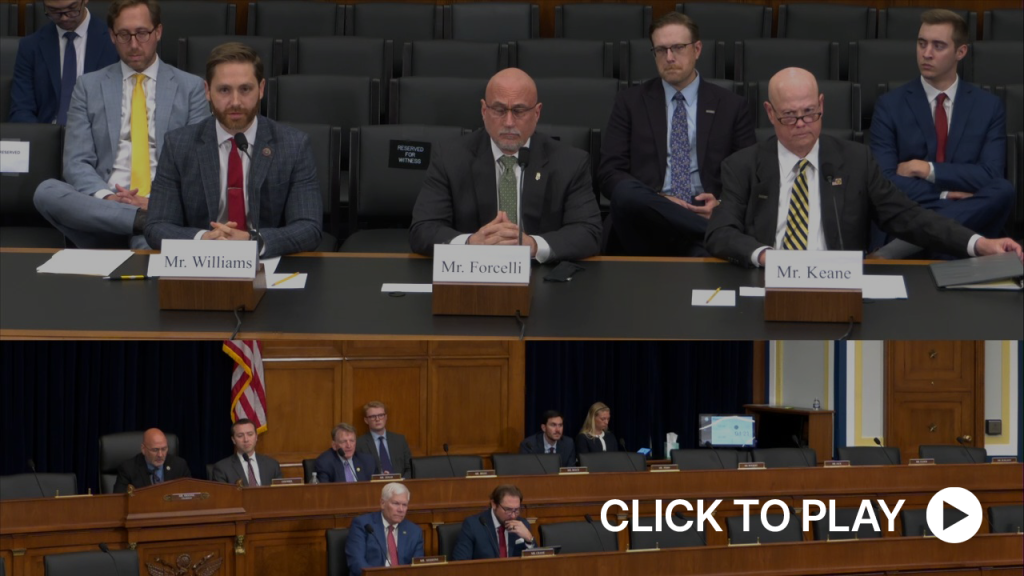
Subcommittee Chairman Higgins: “So, because I just want to clarify that we’re not just talking about one administration, we’re not. I’m actually not trying to you know, place undue blame on the previous administration, certainly not the current administration, whom I love and support the I do. We’re talking about correcting a generational mistake of, of criminalizing ownership and possession of a of a firearm safety device, the suppressor itself. Mr. Williams, a suppressor, if it’s not attached to a firearm, if there’s no firearm involved, is it any more dangerous than a hammer?”
Mr. Williams: “No, sir. It is effectively a paperweight.”
Subcommittee Chairman Higgins: “It’s a paperweight. So we have criminalized the ownership and possession of a chunk of iron. That is basically a club. If it if it’s not attached to a firearm. So we’re talking about correcting a, you know, 90 years of error…I’m talking about Americans that have been charged strictly under the under the prior and existing laws that regulate suppressors and make it a federal crime to possess an unregistered suppressor. So, what would you say, Mr. Keane? What would you say to the American family who’s currently incarcerated for only that charge? What are we going to do about it? Would you turn your mic on, please, sir?”
Mr. Keane: “We need to repeal suppressors from the Hearing Protection Act, because, as you point out, it does not cause harm.”
Rep. Eli Crane (R-Ariz.) asked Peter Forcelli, Deputy Assistant Director (retired) of the Bureau of Alcohol, Tobacco, Firearms and Explosives, and Lawrence Keane about how often suppressors were involved in violent crime.
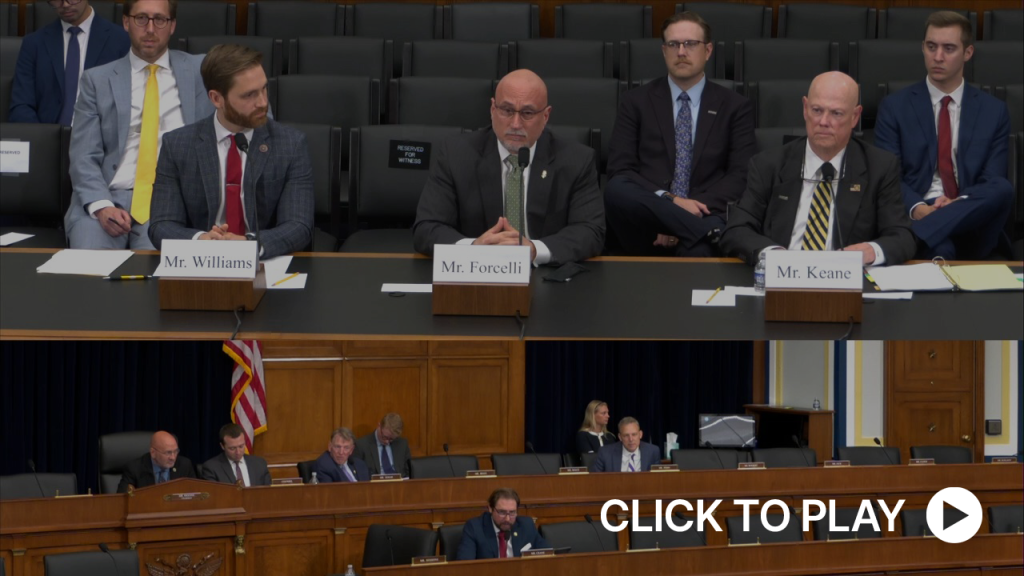
Rep. Crane: “How many crimes did you investigate, sir? Were suppressors were used?”
Mr. Forcelli: “Two. Both of them were search warrants. Both of them were instances where people were involved in narcotics trafficking. Those firearms were not used in any violent crime other than being present at the scene of the warrant. And in the roughly 600 murders that I investigated as a detective with the NYPD, none involved suppressors. So, in 35 years I encountered two suppressors. Both were during search warrants, not incident to any violent criminal acts, just narcotics trafficking.”
Rep. Crane: “Mr. Keene, were you a prosecutor? Is that what you said? Did you have a similar experience?”
Mr. Keane: “I never encountered a case involving a suppressed firearm.”
Rep. Crane: “So why do you think that is? We talked about how you can have a short a small gun, a pistol. You can have a long gun, but it’s these medium sized, you know, guns, short barreled rifles, you know, suppressors that people freak out about. Why do you think that is, Mr. Keane?”
Mr. Keane: “I think they’ve been indoctrinated by Hollywood to believe something that is not the case. And criminals want concealable firearms. Having suppressor on a handgun, as you know, makes it much more difficult to conceal. So, you just do not see them being used in crime in any measurable number. And as I mentioned in my testimony, the massive increase in the number of suppressors in civilian hands now 6.65 million in growing, and a steep increase, hockey stick increase, if you will, in the last several years, you’re not seeing an increase in the use of suppressors in crimes. It’s just a total disconnect that law abiding citizens having this hearing protection device somehow will translate to more violent crime. Quite the opposite.”
Rep. Crane: “And we’ve talked about your two individual experiences, but can we broaden the scope for a bit in looking at FBI statistics? Can you guys present us with any of the statistics as far as nationwide, how many criminals are actually using suppressors in crimes?”
Mr. Forcelli: “They’re almost a non-entity, sir. They’re not. And neither are short barreled rifles. To be candid. Um, again, the short barreled rifles, no different than a AR-15 short barreled rifle is no less, um, firearm than AR-15 pistol, which you can buy. That’s not in the NFA. But to the points made earlier when you put a suppressor on a pistol, that nine-inch pistol, six-inch pistol becomes approximately a foot to maybe 17-inch pistol, depending on which suppressor you have and the length of the pistol, right? So, it makes a firearm less concealable, which criminals don’t want. And candidly, you fire a couple rounds through a suppressed pistol, and you try to put that firearm back in your pants as criminals tend to carry them. You’re in for a rude awakening because your skin’s coming off. Right. So again, I think they’re inconsequential to violent crime.”
Click here to watch the roundtable.
Legal Disclaimer:
EIN Presswire provides this news content "as is" without warranty of any kind. We do not accept any responsibility or liability for the accuracy, content, images, videos, licenses, completeness, legality, or reliability of the information contained in this article. If you have any complaints or copyright issues related to this article, kindly contact the author above.
