

Flow Cytometry Market to reach USD 13.58 Billion by 2035 at 8.2% CAGR
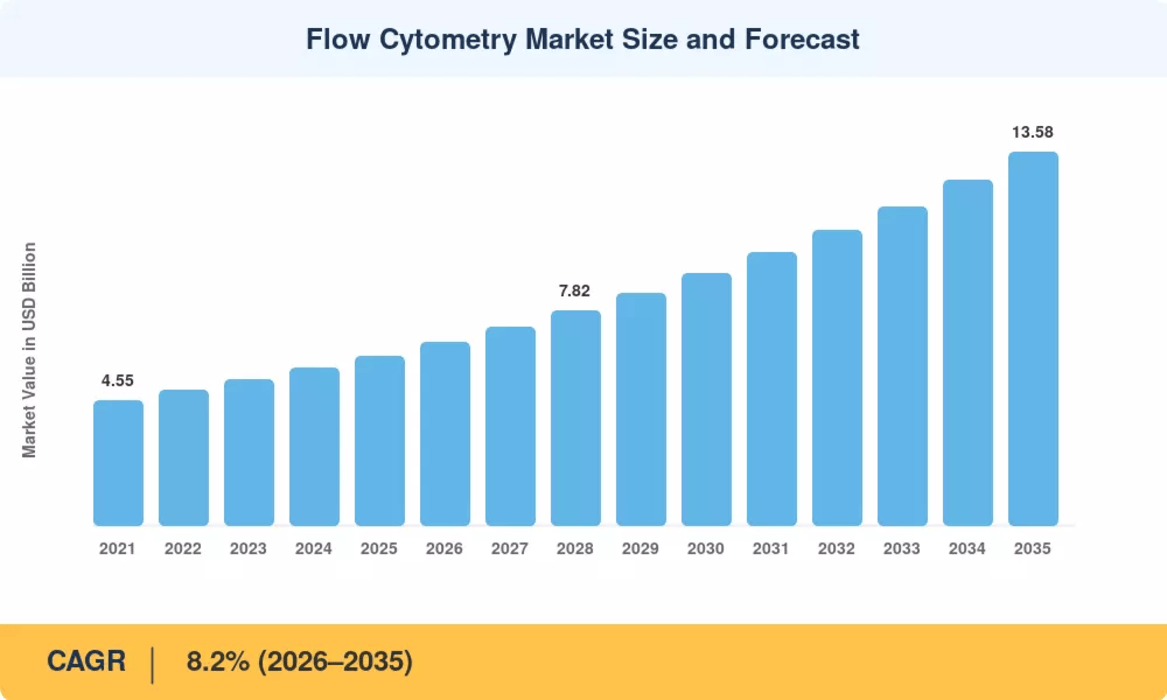
Flow Cytometry Market (2026 - 2035)
Flow Cytometry Market to Surge from USD 6.17 Billion in 2025 to USD 13.58 Billion by 2035—By Cell and Gene Therapy Pipelines, Spectral Instrument Replacement
NY, CA, UNITED STATES, September 3, 2026 /EINPresswire.com/ -- As per Market Research Future, the global Flow Cytometry Market size is projected to reach USD 13.58 Billion by 2035 from USD 6.17 Billion in 2025, at a CAGR of 8.2% during the forecast period 2026–2035. The market base was estimated at USD 6.17 Billion in 2025.The 8.2% CAGR—anchored by structural shifts in cellular analysis and precision medicine—is propelled by three converging forces: the surge in cell and gene therapy clinical pipelines, with more than 2,000 active clinical studies worldwide requiring high-parameter cytometry for release testing, driving manufacturers to place GMP-qualified analyzers inside production suites; the spectral instrument replacement cycle, as filter-based analyzers deployed between 2012 and 2018 approach end-of-service life and labs consolidate legacy systems into 40-parameter spectral platforms; and sustained U.S. federal research funding, including the National Cancer Institute's annual allocated research budget considerably beyond USD 7 billion, which keeps academic and translational laboratories in a continual equipment refresh cycle.
Global life sciences companies and research institutions are amplifying this momentum. BD (Becton, Dickinson and Company) holds an estimated 24–28% revenue share in the global flow cytometry market, reflecting its clinical installed-base leadership. Beckman Coulter Life Sciences (Danaher) commands approximately 15–19% of the market, supported by strong hospital and research dual presence. The U.S. National Cancer Institute maintains consistent investment in cellular therapy and precision oncology initiatives, while global leukemia and lymphoma incidence exceeds 1.3 million new cases annually. These forces are creating the clinical infrastructure and research demand on which the Flow Cytometry Market depends.
Request A Free Sample:
https://www.marketresearchfuture.com/sample_request/6433
Key Market Trends & Growth Drivers
Rising Demand for Cell and Gene Therapy Quality Control
The market is witnessing increasing demand for high-parameter cytometry in cell and gene therapy manufacturing. As more than 2,000 active clinical studies worldwide require release testing, cytometry has become the gold standard for confirming identification, purity, and potency of every autologous CAR-T batch before release. This trend indicates a shift toward decentralized quality control, with manufacturers placing GMP-qualified analyzers inside production suites instead of shipping samples to central labs.
Advancements in Spectral Instrument Technology
Innovations in spectral detection systems are becoming a hallmark of the industry. Labs consolidating four legacy analyzers to one 40-parameter spectral platform report reagent panel savings approaching 30% and a considerable reduction in sample volume per assay. Vendors including Beckman Coulter, Sony, Agilent, and Cytek have expanded their spectral portfolios between 2023 and 2025. The Flow Cytometry Market has absorbed this supply without discounting pressure, signaling genuine replacement demand.
Integration of Software and Analytics as Revenue Lines
The incorporation of cloud-hosted gating, audit-trail management, and machine-learning population identification is gaining traction. Tools such as automated analysis platforms are moving from bundled freebies to subscription products. Software already grows faster than any hardware line at a 12.6% CAGR, and per-seat licensing gives suppliers annuity revenue independent of capital budget cycles.
Increasing Prevalence of Hematologic Malignancies
The rising incidence of leukemia and lymphoma is a primary driver. Global leukemia and lymphoma incidence exceeds 1.3 million new cases annually, and residual-disease assessment protocols now specify eight-color minimum panels as standard of care in most tertiary centers. The market is projected to expand as healthcare providers increasingly adopt multi-marker cellular assays for diagnostic and monitoring applications.
Ask for Customization:
https://www.marketresearchfuture.com/ask_for_customize/6433
Market Segment Insights
BY PRODUCT AND SERVICES
Reagents & Consumables: Largest segment with 54% share in 2025, the single largest recurring revenue pool driven by per-test consumption and validated protocol lock-in.
Software: Fastest-growing segment, posting a 12.6% CAGR through 2035 as high-parameter data complexity drives demand for cloud-hosted analytics and machine-learning tools.
Instruments: Generated USD 2.04 Billion in 2025, weighted toward cell analyzers over sorters, supported by routine diagnostic throughput demand.
Services: Reached USD 0.49 Billion in 2025, driven by uptime guarantees in clinical settings and service contract escalation.
BY TECHNOLOGY
Cell-Based Flow Cytometry: Dominant technology with 79% share in 2025, serving as the core diagnostic and research application engine.
Bead-Based Flow Cytometry: Fastest-growing technology, expanding at a 10.8% CAGR, displacing plate-based immunoassays where multiplexed soluble analyte quantification matters.
BY APPLICATION
Clinical Diagnostics: Largest segment with 38% share in 2025, led by hematologic malignancy workflows and residual-disease assessment protocols.
Industrial Applications: Fastest-growing application, expanding at a 10.2% CAGR, supported by rapid microbial and quality control testing in food, beverage, and pharmaceutical water systems.
Drug Discovery & Development: Growing at a 9.1% CAGR as preclinical screening and cell therapy release testing scales.
Research Applications: Valued at USD 1.36 Billion in 2025, fueled by academic and translational immunology grant-funded instrumentation.
BY END USER
Hospitals & Clinics: Largest segment, generating USD 2.10 Billion in 2025 demand, driven by inpatient diagnostic volume and hematology reference centers.
Academic & Research Institutes: Fastest-growing end user, expanding at an 8.4% CAGR, fueled by grant-funded instrumentation and NIH shared-instrumentation grant mechanisms.
Commercial Organizations: Significant share at 27% in 2025, reflecting pharma and biotech pipeline activity and biosimilar manufacturing QC demand.
Clinical Testing Laboratories: Account for 12% share in 2025, serving send-out specialty testing and CLIA-certified laboratory networks.
Read Detailed Insights:
https://www.marketresearchfuture.com/reports/flow-cytometry-market-6433
Regional Outlook
North America — Market Leader in Innovation
North America leads with 41.5% of global revenue in 2025, generating around USD 2.56 Billion. The region's growth is driven by the highest density of clinical trial sites and CLIA-certified laboratories, sustained National Institutes of Health extramural awards, and the U.S. Food and Drug Administration's cellular therapy review activity. The U.S. commands 87% of regional share, supported by dense reference laboratory networks, while Canada generates USD 0.21 Billion through provincial cancer agency procurement. The competitive landscape is characterized by continuous spectral innovation and strategic portfolio expansion among leading life sciences companies.
Europe — Second Largest Market
Europe was valued at USD 1.66 billion in 2025, representing the second-largest regional market. The region benefits from the EuroFlow consortium's harmonized panels embedded in routine leukemia diagnostics and strong biopharma R&D density. Regulatory bodies like the EMA are actively managing In Vitro Diagnostic Regulation (IVDR) compliance timelines, with Regulation (EU) 2024/1860 extending transitional provisions. Leading countries include Germany, the UK, and Italy, where major companies such as Beckman Coulter, Miltenyi Biotec, and Merck KGaA are heavily invested.
Asia-Pacific — Rapidly Growing Market Segment
The Asia-Pacific region advances at a 10.4% CAGR, the fastest regional rate tracked. The growth is driven by expanding tertiary oncology capacity in China and India, government initiatives aimed at improving healthcare infrastructure, and private diagnostic chain expansion. Countries like China and India are experiencing a surge in demand, with China's provincial cancer-center programme and India's Ayushman Bharat hospital network commissioning diagnostic laboratories at pace. The competitive landscape is evolving with companies like Sysmex, Sony, and domestic Chinese manufacturers leading the charge.
Middle East and Africa — Untapped Potential
The MEA region advances at an 8.9% CAGR, driven by sovereign health infrastructure programmes, medical tourism positioning, and donor-funded laboratory capacity. Countries like Saudi Arabia and the UAE are leading the way through Vision 2030 hospital construction, while South Africa's national HIV monitoring infrastructure represents one of the largest single-application installed bases anywhere. The growing presence of international life sciences companies is expanding access to advanced cytometry platforms.
South America — Emerging Opportunity
South America reached USD 0.30 Billion in 2025, with Brazil commanding 61% of regional share through SUS oncology network procurement. Public procurement dominates, with ANVISA registration timelines determining supplier eligibility. Currency volatility remains a persistent commercial risk, pushing several vendors toward local-currency service contracts.
Competitive Landscape and Recent Developments
The Flow Cytometry market is characterized by intense competition and rapid technological evolution, driven by increasing demand for high-parameter analysis and cell therapy quality control. The global industry appears moderately to highly concentrated, with the top five suppliers holding an estimated 62–70% of global revenue.
KEY COMPANIES AND RECENT MILESTONES
BD (Becton, Dickinson and Company) (US): Holds an estimated 24–28% revenue share as the clinical installed-base leader. In May 2023, introduced the FACSDiscover S8 Cell Sorter with real-time image-enabled sorting, extending sorting decisions beyond fluorescence intensity alone.
Beckman Coulter Life Sciences (Danaher) (US): Commands approximately 15–19% of the market with strong hospital and research dual presence. In 2023, expanded the CytoFLEX family with spectral detection capability aimed at high-parameter research laboratories.
Cytek Biosciences (US) (May 2023): Completed acquisition of the Luminex flow cytometry and imaging business from DiaSorin, adding established platforms to its spectral portfolio. Holds an estimated 4–6% revenue share as a disruptor in spectral platforms.
Agilent Technologies (US) (2024): Launched the NovoCyte Opteon spectral analyzer, positioning against established benchtop competitors. Holds an estimated 4–6% revenue share.
Standard BioTools (US) (January 2024): Closed its merger with SomaLogic, combining high-parameter cytometry with proteomic measurement. Holds an estimated 1–3% revenue share in mass cytometry niche.
Other Key Players: Thermo Fisher Scientific (US), Sony Biotechnology (US), Bio-Rad Laboratories (US), Miltenyi Biotec (DE), Merck KGaA (DE), DiaSorin (IT), Sysmex Corporation (JP).
Future Outlook: 2026–2035
The Flow Cytometry Market is projected to reach USD 13.58 billion by 2035, growing at a CAGR of 8.2%, driven by cell and gene therapy pipeline expansion, spectral instrument replacement cycles, and software analytics monetization.
New opportunities lie in:
Expansion into emerging markets with localized service coverage and regionally manufactured reagents
Development of compact, closed-system analyzers for point-of-care cell therapy manufacturing
Investment in cloud-hosted analytics and machine-learning population identification as subscription revenue lines
Convergence with single-cell multi-omics, positioning cytometry as the high-throughput screening layer for downstream molecular characterization
By 2035, the Flow Cytometry Market is expected to achieve substantial growth and innovation, with value shifting away from hardware and toward the recurring reagent, software, and service layers built on top of it.
More Related Research Insights:
https://www.marketresearchfuture.com/zh-cn/reports/bioanalytical-testing-services-market-6573
https://www.marketresearchfuture.com/ko/reports/bioanalytical-testing-services-market-6573
https://www.marketresearchfuture.com/fr/reports/biosensor-market-1228
https://www.marketresearchfuture.com/ja/reports/biosensor-market-1228
https://www.marketresearchfuture.com/de/reports/biosensor-market-1228
https://www.marketresearchfuture.com/ja/reports/blood-glucose-monitoring-market-557
https://www.marketresearchfuture.com/fr/reports/blood-testing-market-5797
https://www.marketresearchfuture.com/ja/reports/blood-testing-market-5797
https://www.marketresearchfuture.com/de/reports/blood-testing-market-5797
https://www.marketresearchfuture.com/fr/reports/canine-atopic-dermatitis-market-30262
Market Research Future
Market Research Future
+1 855-661-4441
email us here
Legal Disclaimer:
EIN Presswire provides this news content "as is" without warranty of any kind. We do not accept any responsibility or liability for the accuracy, content, images, videos, licenses, completeness, legality, or reliability of the information contained in this article. If you have any complaints or copyright issues related to this article, kindly contact the author above.
